
What's Happening?
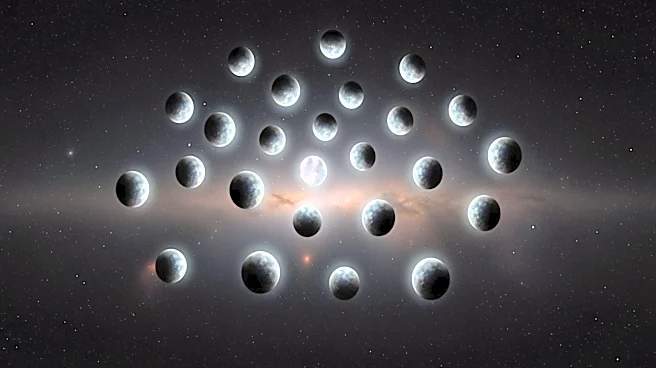
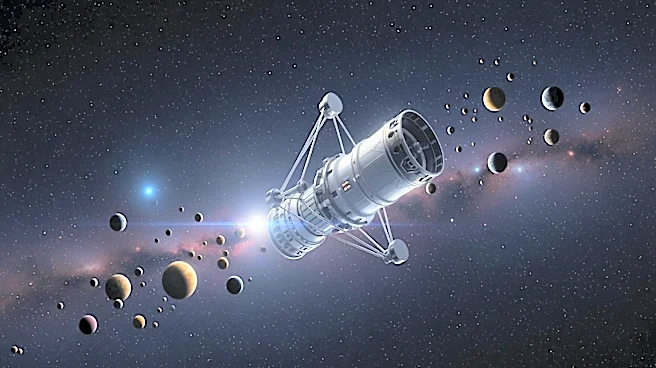
NASA's Transiting Exoplanet Survey Satellite (TESS) has identified more than 10,000 candidate exoplanets, marking the largest single discovery of potential planets. Launched in 2018, TESS is designed to
detect exoplanets by observing dips in starlight as planets pass in front of their stars. The recent analysis, led by Joshua Roth at Princeton University, re-examined the first year of TESS data, revealing 11,554 candidate exoplanets, with 10,091 being newly identified. These candidates extend up to 6,800 light-years from Earth, doubling the previous search range. The majority are hot Jupiters, with a smaller number being Neptunes and super-Earths. However, not all candidates will be confirmed as planets, as TESS has a false positive rate of about 50%.
Why It's Important?
The discovery of over 10,000 new exoplanet candidates significantly expands the potential for understanding planetary formation and diversity. This trove of data could increase the known number of exoplanets by half, providing a larger sample for scientists to study. Understanding the variety of exoplanets, such as different types of Jupiters, can offer insights into planetary systems' formation and evolution. This discovery also underscores the capabilities of TESS in expanding the search for exoplanets beyond previous limits, potentially leading to new scientific breakthroughs in astronomy and astrophysics.
What's Next?
Each candidate exoplanet will require independent verification by other telescopes to confirm their status as planets. This process will help refine the list of true exoplanets and eliminate false positives. As more data is analyzed, the number of confirmed exoplanets is expected to grow, potentially reaching between 12,000 to 15,000. This ongoing research will continue to inform our understanding of the universe and may lead to the discovery of planets with conditions suitable for life.