



What's Happening?
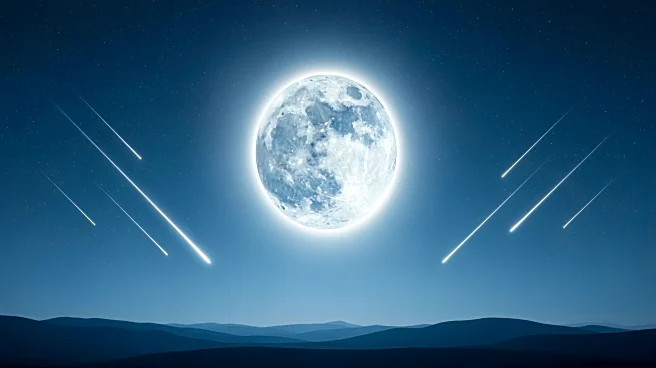
On January 2, 2026, sky watchers are treated to a celestial event as the Quadrantid meteor shower coincides with a Full Super Moon, known as the Wolf Moon. This Super Moon is the last in a sequence of four that began in October 2025. Despite the bright
moonlight, which diminishes the visibility of the meteor shower, brighter fireballs remain visible. The Earth also reaches its perihelion, the closest point to the Sun, at noon EST on the same day. Additionally, the Moon, located in Gemini, passes 4° north of Jupiter, offering a spectacular view for astronomy enthusiasts.
Why It's Important?
The convergence of these astronomical events provides a unique opportunity for both amateur and professional astronomers to observe and study celestial phenomena. The Super Moon, being closer to Earth, appears larger and brighter, enhancing public interest in astronomy. The Quadrantid meteor shower, known for its bright fireballs, offers a chance to witness meteors despite the challenging conditions posed by the moonlight. Such events can inspire educational outreach and increase public engagement with science, fostering a greater appreciation for space exploration and celestial observation.
What's Next?
Astronomy enthusiasts can look forward to future celestial events, with the next Super Moon expected in November 2026. Observatories and space agencies may use these events to promote public interest in space science and encourage participation in observational activities. Educational institutions might organize viewing events to engage students and the community, leveraging the public's fascination with space to promote STEM education.