






What's Happening?
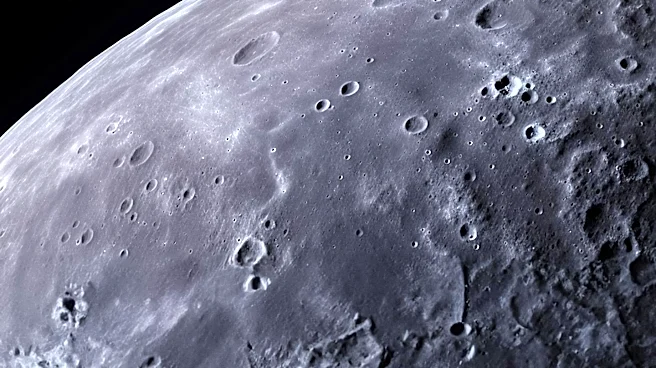
Researchers have successfully extracted water from lunar soil and converted it into oxygen and rocket fuel using sunlight, as reported in a study published in July 2025. This breakthrough was achieved by a team working with material returned by China's
Chang'e-5 mission. The process involved using concentrated light to release water from the lunar soil, which was then used in reactions to produce oxygen, hydrogen, and carbon monoxide. This method reduces the need to transport water from Earth, where the cost of launching a single gallon is estimated at $83,000. The experiment demonstrated the potential for in-situ resource utilization on the Moon, combining water extraction and chemical conversion into a single photothermal process.
Why It's Important?
This development is significant for future lunar missions and the potential establishment of a sustainable human presence on the Moon. By producing essential resources like oxygen and fuel directly on the lunar surface, the dependency on Earth for supplies could be significantly reduced. This could lower the costs and logistical challenges associated with space exploration. The ability to generate oxygen and fuel on the Moon could support life-support systems and propulsion needs, making long-term lunar habitation more feasible. This advancement aligns with NASA's goals for in-situ resource utilization, which aims to use local materials to support human activities in space.
What's Next?
The next steps involve transitioning from laboratory demonstrations to practical applications on the lunar surface. This includes developing systems that can operate in the harsh lunar environment, handling challenges such as low gravity, radiation, and temperature extremes. Future efforts will focus on creating a complete system that can excavate, process, and store resources efficiently. A successful implementation would require a demonstration of sustained operation in conditions that mimic the lunar environment, followed by a small-scale surface demonstration. These advancements are crucial for reducing the need to transport resources from Earth and enabling more extensive exploration and habitation of the Moon.