
What's Happening?
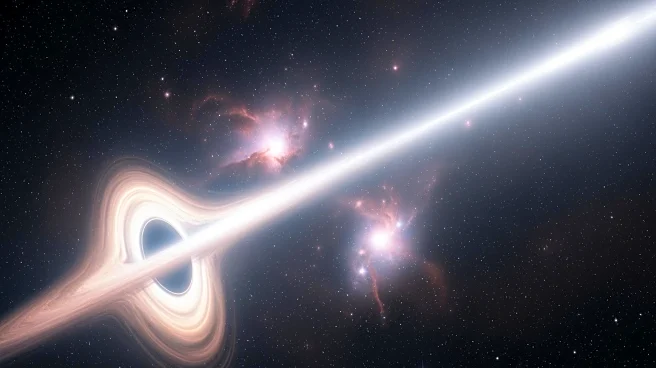
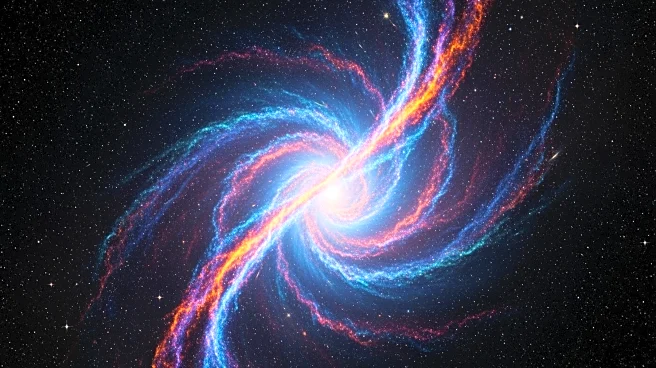
Scientists have successfully traced a 3,000-light-year-long cosmic jet emanating from the supermassive black hole M87, located in the Messier 87 Galaxy, approximately 55 million light-years from Earth.
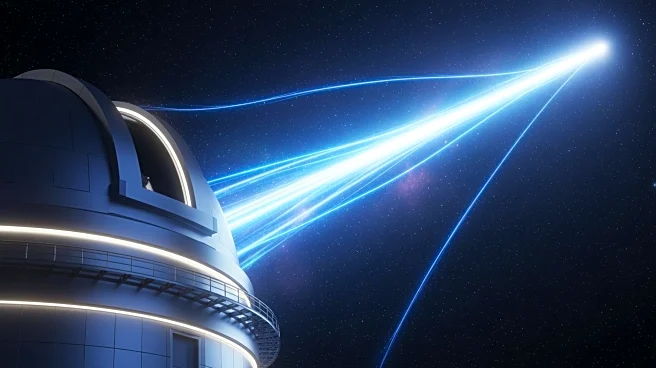
This discovery was made possible through the enhanced capabilities of the Event Horizon Telescope, a global network of eight radio observatories. The study, published in the journal 'Astronomy & Astrophysics,' provides insights into the origin and mechanics of these vast cosmic jets, which travel at nearly the speed of light. The M87 black hole, which is 6.5 billion times larger than the sun, was first imaged in 2019. The research highlights the active nature of M87, which not only absorbs surrounding gas and dust but also emits powerful jets of charged particles from its poles.
Why It's Important?
This discovery is significant as it bridges theoretical concepts about jet launching with direct observational evidence, enhancing our understanding of black hole mechanics. The findings could lead to a deeper comprehension of how supermassive black holes operate and influence their surrounding environments. This research is crucial for astrophysics, as it provides a clearer picture of the dynamic processes at play in the universe. The ability to pinpoint the origin of these jets could also inform future studies on the role of magnetic fields in jet formation and the lifecycle of black holes. Such insights are vital for advancing our knowledge of cosmic phenomena and the fundamental forces shaping galaxies.
What's Next?
Future observations with the Event Horizon Telescope, incorporating higher sensitivity and expanded frequency ranges, are anticipated to provide more precise data and confirm these findings. The study's authors emphasize the need for additional stations and improved intermediate-baseline coverage to refine their understanding of the jet's origin and its connection to the black hole's shadow. These advancements could lead to breakthroughs in identifying the mechanisms behind jet launching and the behavior of active black holes. Continued research in this area is expected to yield further insights into the complex interactions between black holes and their cosmic environments.