
What's Happening?
The Supreme Court's stance on religious displays on public property remains a complex issue, as highlighted by the Alleghany County v. American Civil Liberties Union case. This 1989 decision distinguished
between displays promoting specific religious beliefs and those acknowledging cultural diversity. The case involved a nativity scene and a menorah on government property in Pittsburgh, with the court ruling the nativity scene unconstitutional for promoting a particular belief. The Foundation for Individual Rights and Expression emphasizes that government entities cannot discriminate between religious displays if public property is offered for such purposes. Recent shifts in the Supreme Court's approach, favoring the free exercise of religion, have further complicated the matter.
Why It's Important?
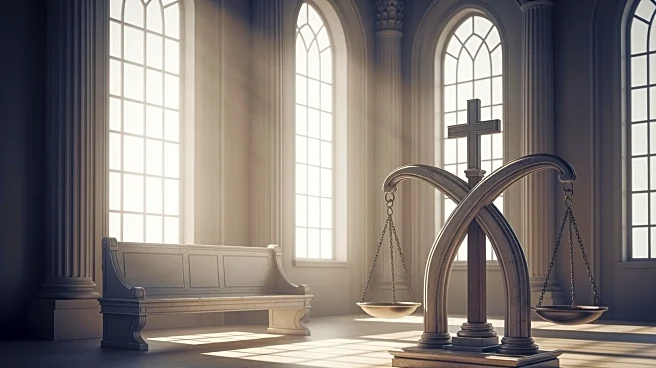
The ongoing debate over religious displays on public property underscores the tension between the First Amendment's Establishment Clause and the free exercise of religion. This issue has significant implications for how government entities navigate religious expression, potentially affecting public policy and societal norms. The Supreme Court's evolving stance could lead to increased permissiveness in religious displays, impacting how diverse cultural traditions are recognized in public spaces. This development is crucial for religious groups seeking equal representation and for maintaining a balance between religious freedom and secular governance.
What's Next?
Future cases may further clarify the boundaries of religious expression on public property. The Supreme Court's current composition suggests a potential shift towards greater accommodation of religious displays, which could prompt new legal challenges and policy adjustments. Stakeholders, including religious organizations and civil rights groups, are likely to continue advocating for their respective positions, influencing public discourse and legal interpretations.