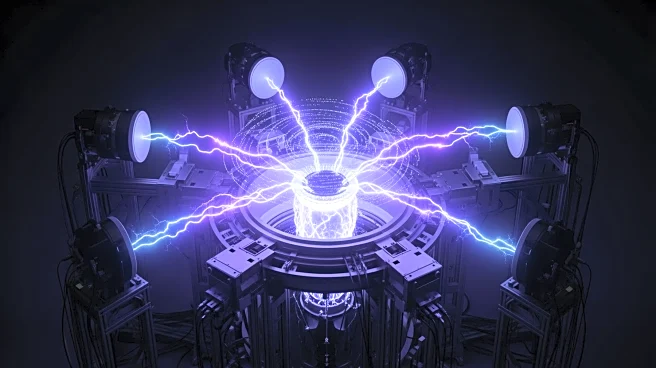




What's Happening?
Physicists, including UC Professor Jure Zupan, have developed a theoretical method to produce axions, hypothetical particles that could explain dark matter, using fusion reactors. This approach, published in the Journal of High Energy Physics, involves
a fusion reactor powered by deuterium and tritium, lined with lithium, which could generate dark sector particles through neutron interactions. The study suggests that these reactors could produce axions or axion-like particles, offering a new avenue for dark matter research. This breakthrough addresses a problem famously tackled by fictional physicists in the TV show 'The Big Bang Theory.'
Why It's Important?
Dark matter is a crucial component of the universe, influencing the motion of galaxies and stars, yet it remains undetected. The proposed method provides a practical approach to potentially observe dark matter particles, advancing our understanding of the universe's composition. If successful, this could lead to significant developments in particle physics and cosmology, offering insights into the fundamental forces and particles that govern the universe.
What's Next?
The implementation of this method in fusion reactors could lead to experimental tests and observations of axions, potentially confirming their existence. This would require collaboration among international research facilities and could pave the way for new technologies in particle detection and energy production.