
What's Happening?
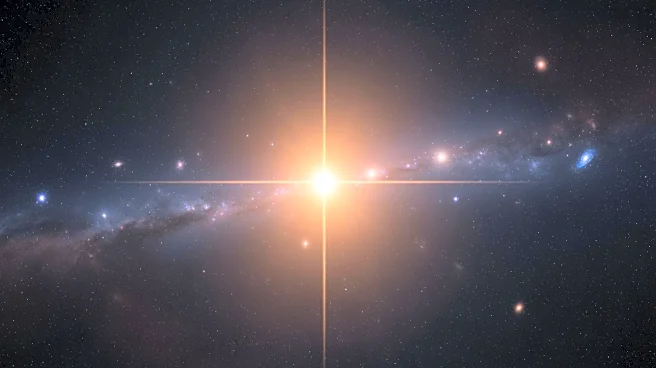
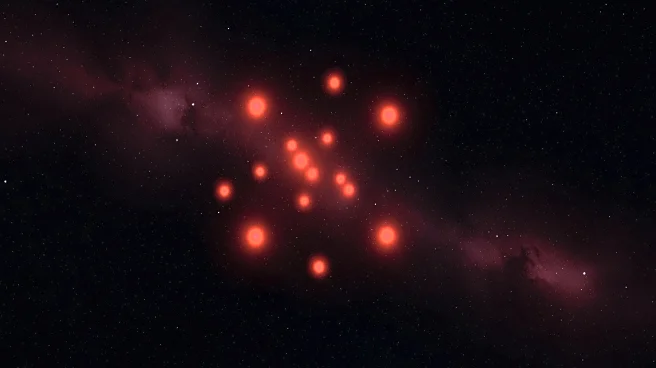
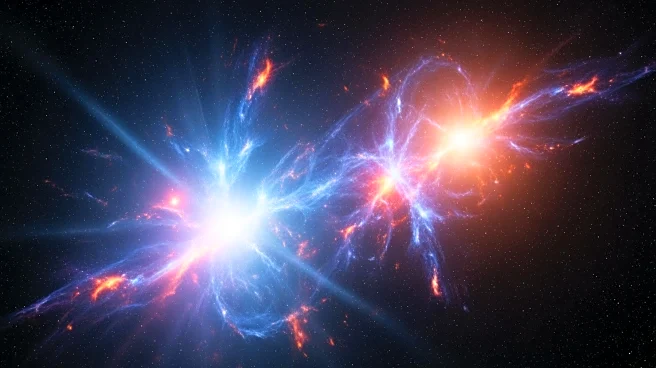
The James Webb Space Telescope (JWST) has captured images of mysterious red dots, sparking speculation about their nature. Initially thought to be powered by black holes, further analysis suggests they may be globular clusters forming new structures,
including a supermassive star. These red dots, viewed as a 'blast from the past,' are seen as red due to their distance, indicating events from the early universe. Researchers are now working to determine their exact nature by analyzing chemical patterns and temperature ranges, which could provide insights into the universe's formation.
Why It's Important?
The discovery of these red dots by the JWST is significant as it could offer a glimpse into the early stages of the universe's development. If confirmed as globular clusters, they may reveal how the first stars and galaxies formed, providing a deeper understanding of cosmic evolution. This research could reshape current theories about the universe's beginnings and the processes that led to the formation of complex structures. The findings have the potential to advance our knowledge of astrophysics and inform future astronomical studies.
What's Next?
Researchers will continue to analyze the red dots to confirm their nature, focusing on detecting chemical patterns and temperature ranges. This ongoing investigation will involve collaboration with other telescopes and scientific instruments to gather comprehensive data. The results could lead to new theories about galaxy formation and the role of black holes in the early universe. As the JWST continues its mission, it is expected to uncover more phenomena that challenge existing scientific paradigms.