




What's Happening?
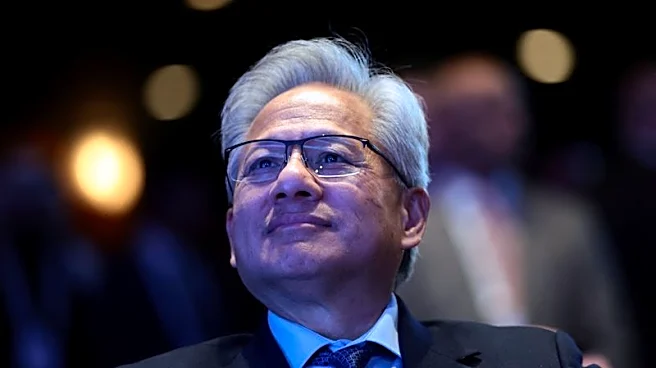
Chinese elites and analysts are presenting a nuanced view on Jensen Huang's departure from NVIDIA, with perspectives ranging from concerns over tightened U.S. export controls to optimism about opportunities for China's domestic AI chip industry. While
some fear that Huang's absence removes a key advocate against stricter U.S. export restrictions, others, like Bai Yuchuan of Shanghai University of International Business and Economics, see it as a chance for domestic computing platforms like Huawei Ascend to expand. An IDC report cited by Chinese sources indicates NVIDIA's market share in China's domestic AI chip market declined to 34% in the first half of 2026, while Huawei accounted for 28%, and other Chinese firms like Cambricon, Alibaba's T-Head, Kunlunxin, and Hygon also gained ground. This suggests a growing belief that Huang's departure could weaken NVIDIA's competitive standing and accelerate China's transition to domestic hardware.
Why It's Important?
This divergence in Chinese perspectives highlights the complex strategic calculations being made in response to U.S. technology policies. For the U.S., the perceived weakening of NVIDIA's influence and the acceleration of China's domestic AI chip development could have significant long-term implications. It suggests that U.S. export controls, while intended to slow China's technological progress, are also inadvertently fostering a robust indigenous industry. This could lead to a more self-reliant Chinese AI ecosystem, reducing its dependence on U.S. technology and potentially challenging U.S. leadership in AI. The shift also indicates that U.S. companies might face increased competition and reduced market access in China, impacting their global market share and innovation cycles.
What's Next?
The prevailing sentiment in China suggests a continued push towards strengthening its domestic AI chip industry. This will likely involve increased government support, R&D investment, and strategic partnerships among Chinese tech companies to develop competitive hardware and software ecosystems. Chinese analysts anticipate a 'warring states period' in the chip industry, characterized by intense competition and innovation in new computing architectures and software. While challenges remain, such as performance gaps and manufacturing yield rates, the focus will be on achieving technological sovereignty. For the U.S., this means a need to continuously evaluate the effectiveness of its export control policies and consider their unintended consequences, as China's drive for self-sufficiency gains momentum.
Beyond the Headlines
The varying Chinese views on Jensen Huang's resignation and the broader U.S.-China tech rivalry underscore a fundamental geopolitical struggle for technological dominance. This competition extends beyond economic gains to national security and strategic influence. The development of independent AI ecosystems in both countries could lead to divergent technological standards, ethical frameworks, and even military applications of AI. This fragmentation could complicate international cooperation on global challenges and potentially lead to a more polarized technological world. The long-term implications include a redefinition of global power dynamics, where technological self-reliance becomes a critical component of national strength and resilience.