



What's Happening?
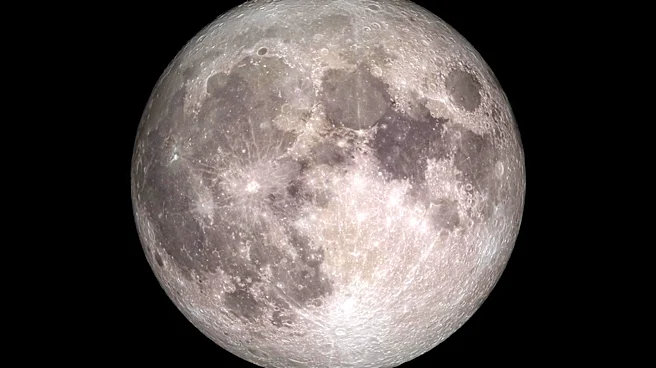
A new study has revealed that the Moon is actively shrinking due to the gradual cooling of its interior, leading to the formation of over 10,000 young tectonic faults on its surface. Researchers, led by Thomas R. Watters of the Smithsonian National Air
and Space Museum, analyzed observations from NASA's Lunar Reconnaissance Orbiter Camera (LROC) to map these faults. The study, published in The Planetary Science Journal, estimates that the Moon's radius has decreased by approximately 45 meters over the past 400 to 800 million years. This contraction creates compressional forces that deform the lunar terrain, forming features like lobate scarps and small ridges in the lunar maria. While the shrinking is imperceptible on human timescales, it represents an ongoing geological process that continues to alter the Moon's crust.
Why It's Important?
This discovery is important for understanding the Moon's internal evolution and its geological activity. Unlike Earth, which has tectonic plates, the Moon behaves as a single-plate body, meaning stress from its contraction can spread across its entire surface. This leads to moonquakes occurring in various regions when existing faults slip or new fractures form. The identification of such a large number of young faults provides valuable insights into how celestial bodies without plate tectonics evolve. For future lunar missions and potential human settlements, understanding the Moon's seismic activity and surface stability is crucial for designing safe and resilient infrastructure. The ongoing changes also offer a unique natural laboratory for studying planetary geology.
What's Next?
As the Moon's interior continues to cool and contract, scientists anticipate that existing faults will continue to grow, and new ones may develop. Further monitoring by missions like the Lunar Reconnaissance Orbiter will be essential to track these changes and refine models of lunar geological processes. Researchers will likely continue to analyze the distribution and characteristics of these faults to better understand regional differences in lunar stability and tectonic deformation. This ongoing research will contribute to a more comprehensive understanding of the Moon's dynamic nature, which could inform future lunar exploration strategies, including the selection of landing sites and the construction of lunar bases.
Beyond the Headlines
The continuous shrinking of the Moon highlights the dynamic nature of celestial bodies, even those seemingly inert. This phenomenon challenges the perception of the Moon as a geologically dead object and underscores the long-term evolutionary processes at play in our solar system. The study's findings also have broader implications for planetary science, offering a comparative perspective on tectonic activity beyond Earth's plate tectonics. Understanding how internal cooling drives surface deformation on the Moon can provide clues about similar processes on other rocky bodies in the solar system. It also emphasizes the importance of long-duration orbital missions in revealing subtle, yet significant, geological changes over vast timescales.