







What's Happening?
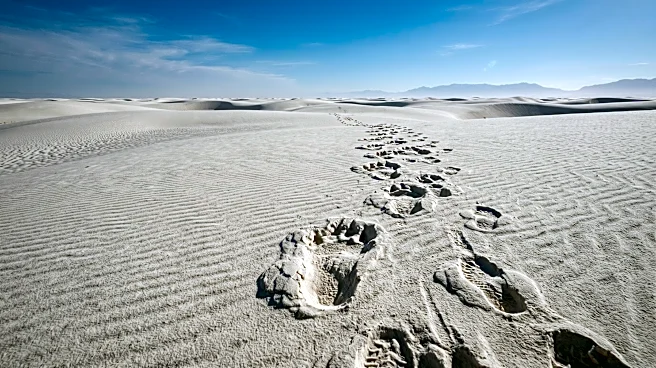
White Sands National Park has introduced a new 0.8-mile 'Ice Age Trail,' formerly known as the Playa Trail, allowing visitors to explore replica fossilized footprints. These prints, some dating back as far as 23,000 years, offer a glimpse into a prehistoric
era when humans coexisted with giant animals in what is now the Tularosa Basin. Resource Management Program Manager David Bustos highlighted the significance of these discoveries, noting that the tracks reveal stories of ancient life, including a mother carrying a child and early humans navigating a challenging environment. The area, once home to a large body of water called Lake Otero, supported abundant vegetation and a diverse array of megafauna, such as mammoths, sabertooth cats, and giant ground sloths. The park continues to uncover and study these unique fossil records, which provide rare insights into the interactions between early humans and Ice Age animals.
Why It's Important?
The unveiling of the 'Ice Age Trail' at White Sands National Park is important for several reasons. It provides tangible evidence of early human presence in North America, potentially pushing back previous timelines for human migration and settlement. The fossilized footprints offer a unique window into the daily lives and challenges faced by prehistoric humans, including their interactions with formidable megafauna. This discovery contributes significantly to the fields of archaeology and paleontology, offering new data for understanding ancient ecosystems and human adaptation. For the public, the trail enhances educational opportunities, allowing visitors to connect directly with a distant past and appreciate the rich natural and historical heritage preserved within national parks. The ongoing research at White Sands could reshape our understanding of the continent's earliest inhabitants and the environmental conditions they encountered.
What's Next?
Park officials are actively working to preserve and study the tens of thousands of prints believed to be hidden beneath the dunes at White Sands National Park. The prints are vulnerable to erosion once exposed, necessitating rapid documentation through casts, molds, and 3D imaging. Future efforts will focus on unearthing more fossil bones, such as the recently discovered mammoth tusk, and continuing to analyze canid prints found alongside human tracks to determine their relationship. Researchers are also collaborating with other organizations across the country, as similar fossil footprints are being discovered in other playas in Arizona, Texas, and California. These ongoing investigations promise to yield further insights into the ancient history of the Americas and the complex interactions between humans and their environment during the Ice Age.
Beyond the Headlines
The discoveries at White Sands National Park extend beyond mere archaeological finds; they challenge conventional narratives about early human life and environmental adaptation. The presence of human footprints within sloth prints, for instance, suggests a pragmatic use of the landscape by early humans, potentially using large animal tracks as pathways. The evidence of hunting parties tracking mammoths and the use of sticks to drag items through mud hint at sophisticated survival strategies and early forms of transportation. Furthermore, the unique preservation conditions at White Sands, where prints were fossilized by clay and repeated drying and filling of Lake Otero, highlight the critical role of specific geological processes in preserving such invaluable historical records. This site serves as a powerful reminder of the dynamic interplay between climate, geology, and the evolution of life, offering profound ethical and cultural reflections on humanity's deep roots and enduring connection to the natural world.