







What's Happening?
Engineers at Northwestern University have introduced a new 3D printing technique called Direct Ink Additive Lithography (DIAL). This method aims to overcome the traditional trade-offs in 3D printing between speed, precision, and material compatibility.
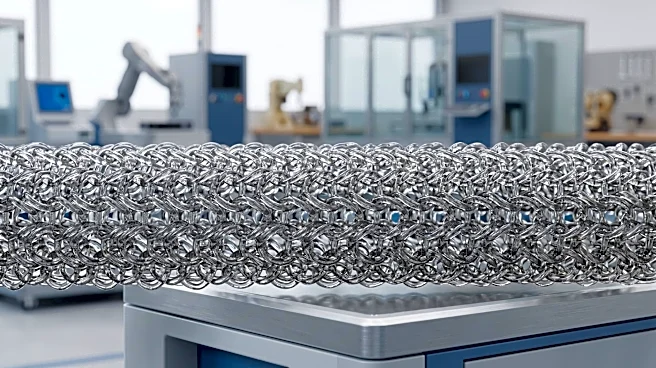
DIAL combines the rapid, high-resolution capabilities of light-based 3D printing with the broad material versatility of extrusion-based printing. Instead of depositing material line by line, DIAL spreads thick, paste-like inks into thin sheets, which are then selectively hardened by patterned light. This process allows for the rapid creation of complex, finely detailed 3D objects without the need for external support structures, as the unhardened ink itself provides support. The research, published in *Science Advances*, demonstrates DIAL's ability to print intricate lattices with walls as thin as 150 microns and interlocking chainmail structures, which were previously challenging for existing methods. The team also showcased DIAL's versatility by printing functional materials like structural electrolytes for batteries and hydrogels for tissue engineering.
Why It's Important?
The development of DIAL is significant because it addresses long-standing limitations in additive manufacturing, potentially unlocking new possibilities across various U.S. industries. By enabling faster, more precise printing with a wider range of functional materials, DIAL could accelerate innovation in fields such as aerospace, robotics, and medicine. For instance, the ability to print structural electrolytes with precise 3D architectures could lead to advancements in energy storage devices, impacting the electric vehicle and renewable energy sectors. In medicine, the capacity to create intricate hydrogel structures could revolutionize tissue engineering and the development of custom medical devices. This breakthrough could also reduce material waste and production time, offering economic benefits through more efficient manufacturing processes. Industries requiring complex, high-performance components stand to gain significantly from this technology, as it allows for the creation of previously unattainable material architectures.
What's Next?
The Northwestern University team anticipates further refining the DIAL method to achieve even faster print times by streamlining the tool-switching process. Future efforts will focus on exploring the full potential of DIAL to print materials and structures capable of withstanding extreme environments, such as those encountered in space travel. Additionally, researchers plan to apply DIAL to create flexible components for robotics, advanced medical devices, and improved tissue culture environments for biomanufacturing. The ability to print materials that were previously unprintable suggests that new applications and industries may emerge as this technology matures. Collaborations with various industries are likely to follow as companies seek to leverage DIAL's unique capabilities for their specific manufacturing needs, potentially leading to new product development and market opportunities.
Beyond the Headlines
Beyond its immediate applications, DIAL represents a fundamental shift in how functional materials can be transformed into useful forms. The method's ability to print without scaffolding and to reuse excess ink highlights a move towards more sustainable and efficient manufacturing practices, addressing environmental concerns related to material waste in 3D printing. The flexibility in material choice, including light-scattering inks, opens up a vast design space for materials scientists and engineers, fostering interdisciplinary research and development. This could lead to the creation of entirely new classes of materials with tailored properties, pushing the boundaries of material science. The ethical implications of creating highly specialized medical devices or advanced robotic components will also become more prominent as the technology becomes more widespread, necessitating careful consideration of regulatory frameworks and societal impact.