






What's Happening?
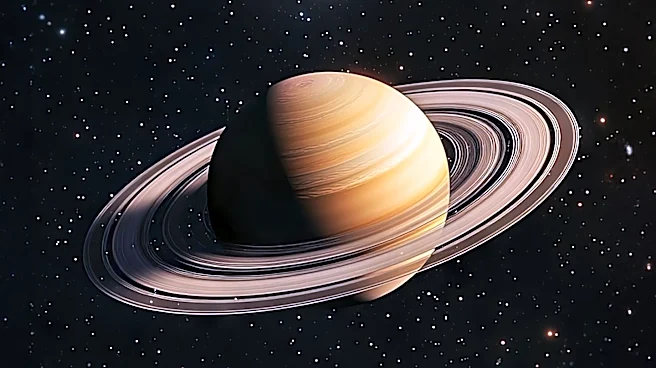
On July 27, 2026, Saturn reaches a stationary point in the constellation Pisces, marking a significant event for astronomers and sky watchers. This occurrence happens as Saturn's motion against the background stars shifts from eastward to westward, a phenomenon
known as retrograde motion. Saturn will be visible in the southeastern sky, appearing as the brightest point of light in the early morning hours. The planet's disk and rings are visible through a telescope, with its largest moon, Titan, positioned nearby. This event provides an opportunity for observers to witness Saturn's transition and the movement of its moons over the coming days.
Why It's Important?
The stationary point of Saturn is a notable event for both amateur and professional astronomers, offering a chance to observe the dynamics of planetary motion. This retrograde motion is a result of the relative positions and movements of Earth and Saturn in their orbits. Such events enhance our understanding of celestial mechanics and the behavior of planets in our solar system. For the public, it provides an engaging opportunity to connect with astronomy and appreciate the complexities of planetary movements. The visibility of Saturn and its moons can inspire interest in space science and observation.
What's Next?
Following this stationary point, Saturn will begin its retrograde motion, moving westward relative to the stars. Observers can continue to track Saturn's position in the sky over the coming weeks, noting its changing location and the movement of its moons. This period of retrograde motion will last for several months, providing ample time for continued observation and study. Astronomers may use this time to gather data on Saturn's atmosphere and rings, contributing to ongoing research and exploration of the gas giant.