


What's Happening?
The James Webb Space Telescope (JWST) has produced one of the most detailed maps of dark matter, a mysterious and invisible substance that constitutes most of the universe. This achievement was made possible through data collected by the JWST, as reported
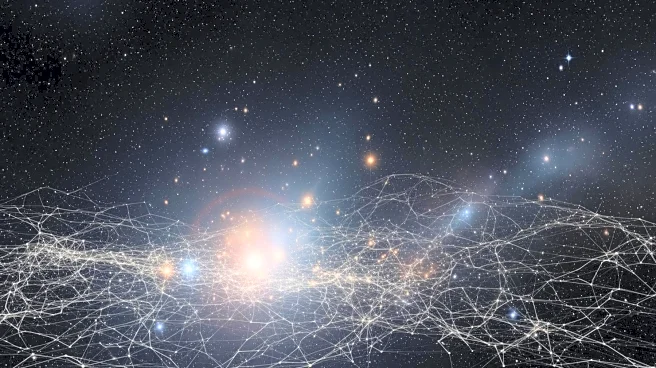
in the journal Nature Astronomy. The map, which is twice as sharp as previous ones, reveals the intricate 'scaffolding' of the universe, showing how dark matter provides the extra gravity needed to keep galaxies intact. The study, led by Diana Scognamiglio from NASA's Jet Propulsion Laboratory, highlights the role of dark matter in maintaining the structure of galaxies, which would otherwise disintegrate due to their rapid rotation.
Why It's Important?
This development is significant as it enhances our understanding of the universe's composition and the role of dark matter. The detailed map confirms that dark matter and regular matter have always co-existed, influencing the formation and distribution of galaxies. This insight is crucial for astrophysics, as it suggests that dark matter's gravitational pull has been instrumental in shaping the universe. The findings also imply that dark matter's influence was essential for the conditions that allowed life to develop, as it facilitated the early formation of galaxies and stars, which are necessary for the creation of complex planets.
What's Next?
Future research will likely focus on further exploring the relationship between dark matter and regular matter, using the JWST's capabilities to map other regions of the universe. Scientists may also investigate how dark matter's gravitational effects have influenced cosmic evolution over time. These studies could provide deeper insights into the fundamental forces that govern the universe and potentially lead to new discoveries about the nature of dark matter itself.
Beyond the Headlines
The implications of this research extend beyond astronomy, touching on philosophical and existential questions about the universe's origins and the conditions necessary for life. Understanding dark matter's role in cosmic history could reshape our perception of the universe and our place within it. Additionally, this research underscores the importance of advanced space telescopes like the JWST in expanding human knowledge and exploring the unknown aspects of the cosmos.