



What's Happening?
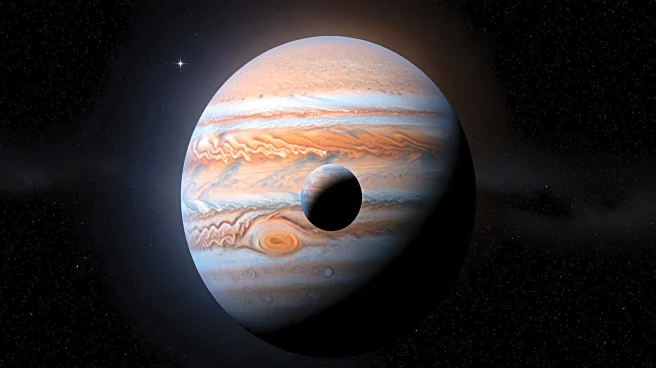
On December 31, 2025, a significant astronomical event will occur as Jupiter's icy moon Europa casts its shadow across the gas giant's cloud tops. This transit begins at 9:01 P.M. EST when Europa's shadow appears on Jupiter's southeastern limb. Europa itself
follows 28 minutes later, and both the moon and its shadow will be visible crossing Jupiter for over two hours. The event is notable as Jupiter approaches opposition, making it highly visible in the constellation Gemini. Europa's shadow will exit Jupiter's disk just before midnight EST, with Europa completing its transit shortly thereafter. This celestial event provides a unique opportunity for astronomers and enthusiasts to observe the dynamics of Jupiter's moons.
Why It's Important?
The transit of Europa across Jupiter is significant for both professional astronomers and amateur stargazers. Such events offer valuable opportunities to study the interactions between Jupiter and its moons, contributing to our understanding of planetary dynamics and celestial mechanics. Observing these transits can also help refine models of Jupiter's atmosphere and the gravitational influences of its moons. For the public, this event serves as an engaging way to connect with astronomy, potentially inspiring interest in space science and exploration. The visibility of Jupiter during opposition enhances the experience, making it an accessible event for those with telescopes or binoculars.
What's Next?
Following this transit, astronomers will continue to monitor Jupiter and its moons, particularly as the planet remains in a favorable position for observation. Future transits and oppositions will provide additional opportunities for study. The data collected during these events can be used to improve our understanding of the Jovian system and inform future missions to Jupiter and its moons, such as the upcoming Europa Clipper mission by NASA, which aims to explore Europa's potential for harboring life.