
What's Happening?
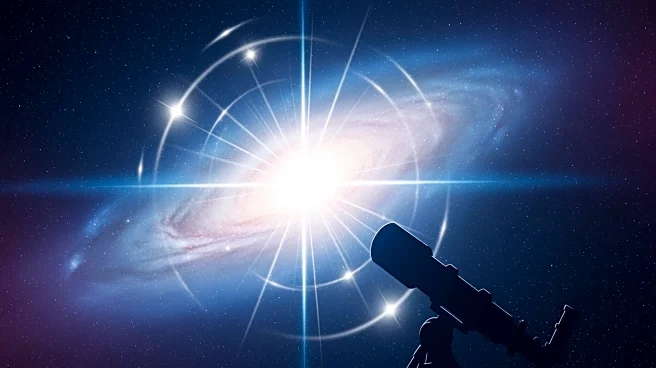
Researchers using NASA's Fermi Gamma-ray Space Telescope may have observed dark matter for the first time. The study, led by Tomonori Totani from the University of Tokyo, suggests that gamma-ray emissions
detected could be the result of weakly interacting massive particles (WIMPs) colliding and annihilating each other. This discovery, if confirmed, would be a significant breakthrough in understanding dark matter, which is believed to make up about 27% of the universe's mass-energy. The findings are based on the observation of gamma rays with a photon energy of 20 gigaelectronvolts, consistent with theoretical predictions for dark matter interactions.
Why It's Important?
The potential detection of dark matter is crucial as it could solve one of the biggest mysteries in cosmology. Dark matter is thought to be the 'invisible glue' that holds galaxies together, yet it has remained elusive due to its non-interaction with electromagnetic forces. Confirming its existence would not only validate decades of theoretical work but also open new avenues for understanding the universe's composition and evolution. This discovery could also impact fundamental physics, potentially leading to new theories beyond the current Standard Model.
What's Next?
The next steps involve independent verification of Totani's findings by other researchers. This includes examining gamma-ray emissions from other cosmic sources to rule out alternative explanations. If confirmed, the discovery could lead to a deeper understanding of dark matter and its role in the universe. Future research will likely focus on refining detection methods and exploring the implications for cosmology and particle physics.