
What's Happening?
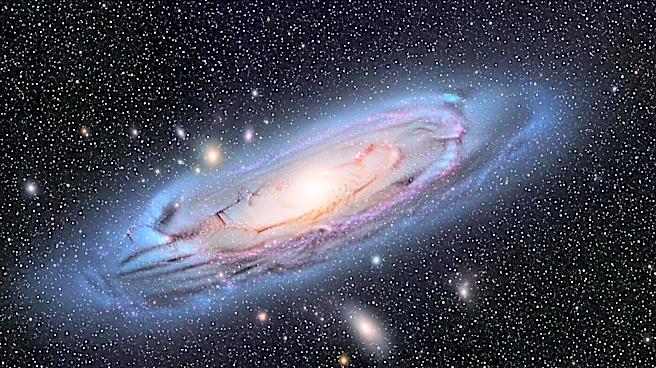
The Hubble Space Telescope has captured an image of NGC 1266, a lenticular galaxy located 100 million light-years away in the constellation Eridanus. This galaxy is classified as transitional, representing
an evolutionary bridge between spiral and elliptical galaxies. The image reveals a bright center with hints of spiral structure, but without obvious spiral arms. The observation of NGC 1266 provides astronomers with valuable data to study the characteristics and evolution of lenticular galaxies.
Why It's Important?
The study of transitional galaxies like NGC 1266 is crucial for understanding the processes that drive galaxy evolution. By analyzing the features of lenticular galaxies, astronomers can gain insights into how galaxies transform over time and the factors that influence their development. The data from Hubble's observations contribute to the broader field of astrophysics, enhancing our knowledge of the universe's structure and the life cycle of galaxies. This research also underscores the importance of space telescopes in advancing our understanding of cosmic phenomena.