
What's Happening?
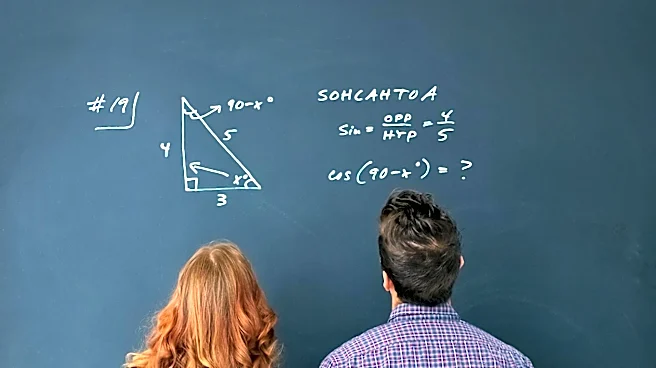
Trigonometry, a fundamental branch of mathematics, focuses on the relationships between the angles and sides of triangles. The core concepts revolve around three primary ratios: sine (sin), cosine (cos),
and tangent (tan), often remembered by the acronym SOH-CAH-TOA. For a right-angled triangle, the cosine of an angle is defined as the ratio of the adjacent side to the hypotenuse (cos θ = Adjacent / Hypotenuse). These ratios are crucial for calculating unknown sides or angles when other information is available. Beyond these basic ratios, trigonometry also includes reciprocal ratios (cosecant, secant, cotangent), Pythagorean identities (e.g., sin² θ + cos² θ = 1), and formulas for complementary angles. These principles are widely applied in various scientific and engineering fields.
Why It's Important?
The understanding and application of trigonometric formulas and ratios are vital across numerous U.S. industries and educational sectors. In engineering, trigonometry is indispensable for designing structures, machines, and electrical systems, ensuring stability and functionality. Architects rely on these principles for accurate building designs and spatial planning. In physics, trigonometry is fundamental to understanding forces, waves, and motion, which underpins advancements in technology and scientific research. For students, mastering these concepts is a prerequisite for higher-level mathematics and STEM fields, directly impacting the pipeline of skilled professionals in critical sectors. The ability to solve problems involving heights, distances, and angles using trigonometry is a foundational skill that supports innovation and practical problem-solving in diverse real-world scenarios, from navigation to computer graphics, thereby contributing to technological progress and economic competitiveness.
What's Next?
The foundational understanding of basic trigonometric ratios and formulas serves as a stepping stone for more advanced mathematical and scientific studies. Students who grasp these concepts will be better prepared for pre-calculus, calculus, and other higher-level mathematics courses, which are essential for careers in engineering, physics, computer science, and data analysis. Educators will continue to refine teaching methodologies to make these concepts more accessible and engaging, potentially incorporating more real-world applications and interactive tools. In professional fields, ongoing advancements in technology and data science will likely lead to new applications and computational methods that build upon these fundamental trigonometric principles. Research in areas like signal processing, computer vision, and robotics will continue to leverage and expand upon trigonometric functions, driving further innovation and development in these critical sectors.
Beyond the Headlines
Beyond their direct application in calculations, trigonometric concepts foster a deeper understanding of spatial relationships and abstract reasoning, which are crucial cognitive skills. The elegance of trigonometric identities, such as the Pythagorean identities, reveals the interconnectedness and underlying order within mathematics, encouraging a more profound appreciation for logical structures. This foundational knowledge also plays a subtle but significant role in the development of technologies that shape modern life, from the algorithms powering GPS systems and digital imaging to the complex simulations used in climate modeling and aerospace. The ability to translate real-world problems into mathematical models using trigonometry empowers individuals to analyze and solve complex challenges, contributing to a scientifically literate populace and driving innovation across various disciplines. It underscores the enduring relevance of classical mathematical principles in an increasingly data-driven and technologically advanced society.