

What's Happening?
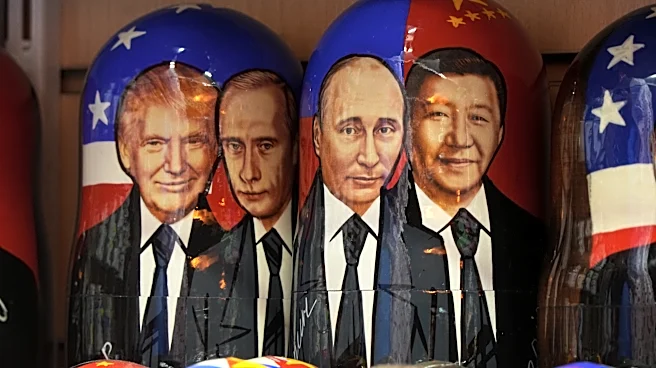
President Trump has announced his intention to meet with the leaders of Russia and China next week in Shenzhen. The primary agenda for this trilateral meeting is to discuss an end to the Iran war, alongside other critical topics such as denuclearization.
This announcement was made by President Trump himself, indicating a high-level diplomatic effort to address significant international security concerns. The Chinese Foreign Ministry Spokesperson, Guo Jiakun, confirmed that China is in communication with relevant parties regarding the meeting of the three presidents but did not offer additional details on the agenda at this time. This upcoming summit highlights a concerted push for diplomatic resolution to ongoing global conflicts and strategic challenges.
Why It's Important?
This trilateral meeting is highly significant due to the involvement of three major global powers—the United States, Russia, and China—in addressing the Iran war and denuclearization. The Iran conflict has broad implications for global energy markets, regional stability in the Middle East, and international security. A resolution could de-escalate tensions, potentially stabilizing oil prices and reducing the risk of broader military engagements. Discussions on denuclearization, particularly in the context of Iran, are crucial for non-proliferation efforts and maintaining the international arms control framework. The participation of China and Russia, both permanent members of the UN Security Council, is essential for any lasting diplomatic solution, as their cooperation can lend significant weight and legitimacy to agreements. The outcome of these discussions could influence U.S. foreign policy, its alliances, and its strategic posture in the Middle East and beyond, impacting global security dynamics and potentially fostering a new era of cooperation or competition among these nations.
What's Next?
The immediate next step will be the trilateral meeting itself in Shenzhen, where President Trump, along with the leaders of Russia and China, will engage in discussions. The specific outcomes of this meeting, including any joint statements, agreements, or further diplomatic initiatives, will be closely watched. Following the summit, there could be subsequent bilateral or multilateral engagements to build upon any progress made. Stakeholders, including other nations involved in the Iran conflict, international organizations, and global markets, will be anticipating the results. The discussions on denuclearization could lead to renewed negotiations or frameworks for arms control, potentially involving other nations. The reactions from political leaders, particularly those in the Middle East and Europe, will be critical in determining the broader impact and acceptance of any proposed solutions. The success of this meeting could set a precedent for future high-level diplomatic efforts to address complex global challenges.
Beyond the Headlines
The convergence of the U.S., Russia, and China to discuss the Iran war and denuclearization points to a potential shift in global diplomatic strategies, emphasizing multilateral engagement even amidst geopolitical rivalries. This meeting could signal a recognition among these powers that certain global crises necessitate collective action, transcending individual national interests. Ethically, the discussions will grapple with the humanitarian implications of the Iran conflict and the moral imperative of preventing nuclear proliferation. Legally, any agreements reached could influence international law and treaties related to arms control and regional security. Culturally, such high-level dialogue, if successful, could foster a greater sense of shared responsibility for global peace and stability, potentially mitigating the 'clash of civilizations' narrative. Long-term, this development could either pave the way for a more cooperative international order or, if unsuccessful, highlight the persistent challenges in achieving consensus among major powers on critical global issues, thereby shaping the future of international relations.