

What's Happening?
A federal judge in Missouri has ordered the state's Secretary of State, Denny Hoskins, to implement the 2025 congressional map for the upcoming November 2026 election. This ruling comes just days after the Missouri Supreme Court declared the new map was
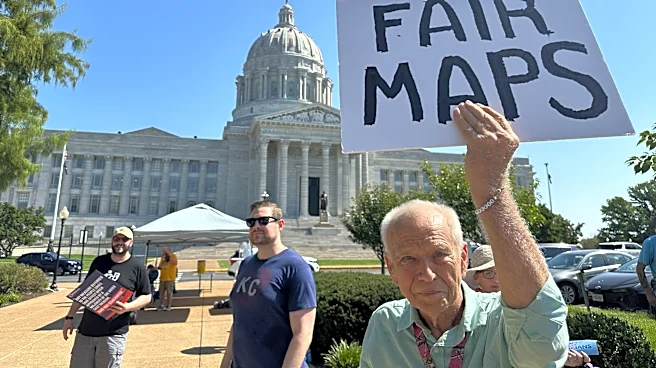
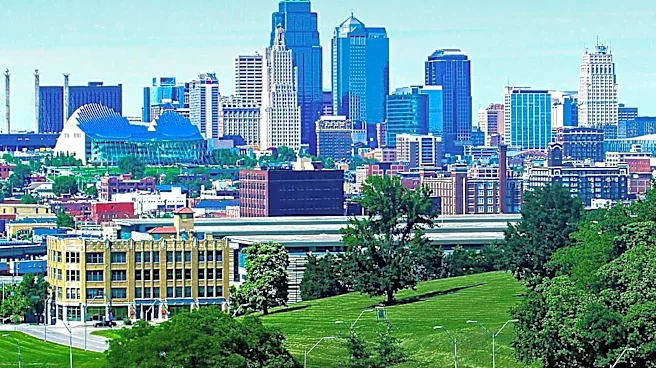
not legally in effect and mandated the use of the older 2022 map. The 2025 map, which was approved by Republicans in the General Assembly, is designed to give the Republican party a theoretical 7-1 advantage in U.S. House seats in Missouri by redrawing the Fifth District of Kansas City, a traditionally Democratic stronghold. The Missouri Supreme Court's decision last week was based on a successful referendum petition challenging the 2025 map, which they deemed lawful and sufficient to suspend the new map's implementation. However, Republican congressional candidates, including Rep. Bob Onder and state Sen. Rick Brattin, filed a lawsuit in federal court to stop the use of the older map, arguing that switching maps after the primary election would cause significant disruption and disenfranchise voters who participated in the August primaries under the 2025 map.
Why It's Important?
This federal court decision has significant implications for the upcoming U.S. House elections in Missouri, potentially altering the political landscape and the balance of power within the state's congressional delegation. The 2025 map, if ultimately used, is expected to solidify Republican control by creating a 7-1 majority, effectively marginalizing Democratic representation, particularly in the Kansas City area. The ongoing legal battle highlights the contentious nature of redistricting and its direct impact on voter representation and electoral outcomes. The dispute also underscores the tension between state and federal judicial authority, as a federal court has now intervened to override a state supreme court's ruling on a matter of state election law. This situation could lead to voter confusion and logistical challenges for election officials, who are already facing tight deadlines for preparing ballots for the November election, including those for military and overseas voters.
What's Next?
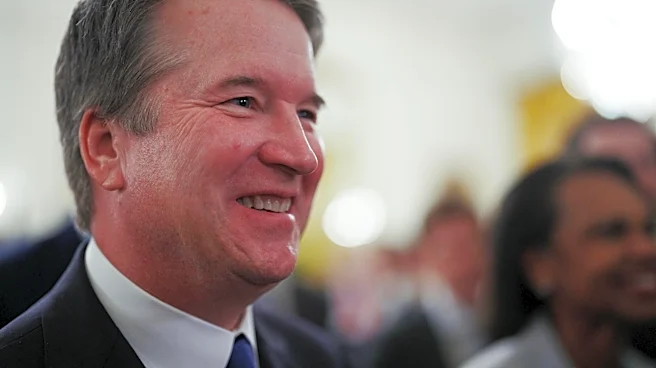
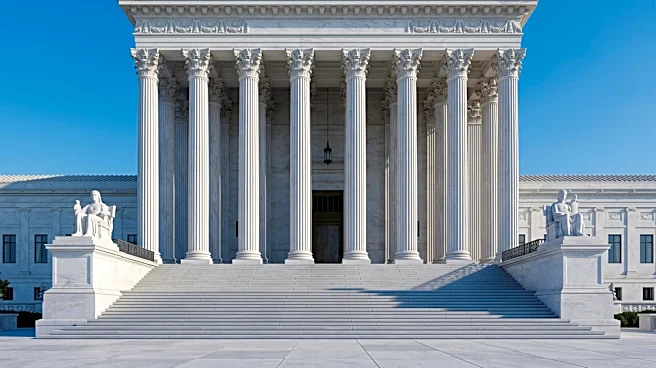
The immediate future of Missouri's congressional map remains uncertain, despite the federal judge's order. The temporary restraining order issued by the federal court is for a period of 14 days, during which the Eastern District court will hear further arguments in the case. Meanwhile, the Missouri Attorney General, Catherine Hanaway, had previously appealed the Missouri Supreme Court's decision to the U.S. Supreme Court, seeking a stay to block the state court's ruling. Although U.S. Supreme Court Justice Brett Kavanaugh rejected Hanaway's request to block the 2022 map, the broader legal challenges are ongoing. The group 'People Not Politicians,' which successfully challenged the 2025 map at the state level, is expected to continue its efforts to ensure the 2022 map is used, arguing that the U.S. Supreme Court lacks jurisdiction over a matter of state law. The ultimate resolution will likely depend on further court decisions and could potentially involve additional appeals, creating continued uncertainty for candidates and voters as the November election approaches.
Beyond the Headlines
This legal saga extends beyond the immediate electoral implications, touching upon fundamental questions of democratic representation and the integrity of the electoral process. The debate over congressional maps, often referred to as gerrymandering, raises concerns about whether elected officials are truly representative of their constituents or if district lines are drawn to favor one political party over another. The involvement of both state and federal courts in this dispute highlights the complex interplay of legal jurisdictions and the potential for judicial intervention to shape political outcomes. Furthermore, the argument that switching maps close to an election could disenfranchise voters or create logistical chaos underscores the fragility of election administration when faced with last-minute legal challenges. This situation could also fuel public distrust in the electoral system, as voters witness ongoing legal battles over the very structure of their representation, potentially leading to decreased participation or increased polarization.