






What's Happening?
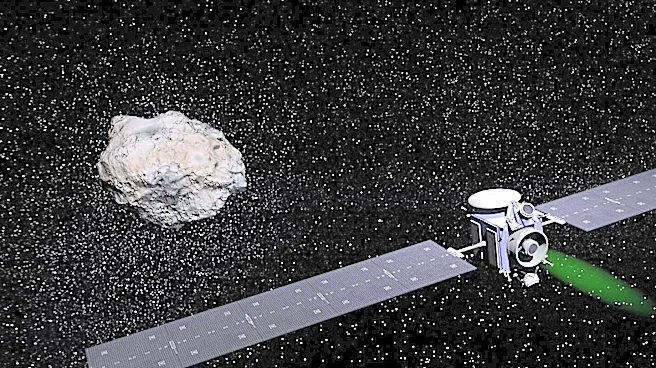
NASA is exploring a new class of reconnaissance spacecraft designed to map minerals from orbit using Raman spectroscopy during high-speed flybys. This innovative approach, if feasible, would allow NASA to evaluate ice and ilmenite on the Moon, assess
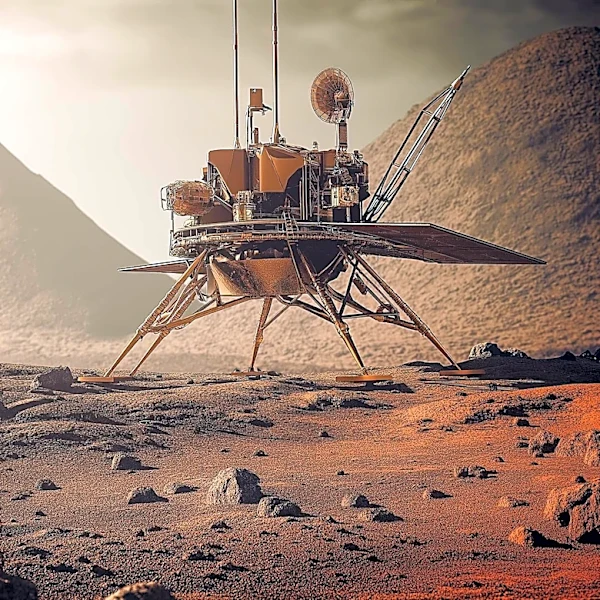
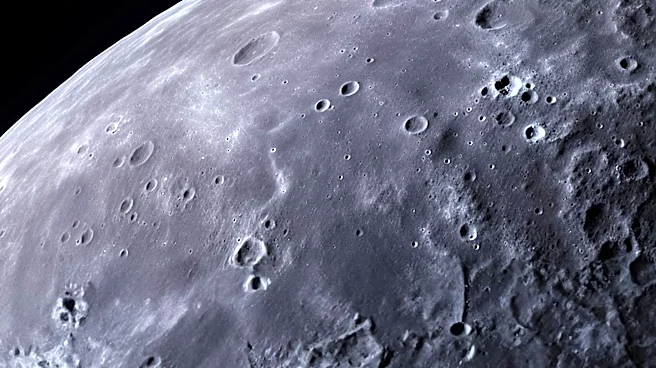
ore content on asteroids, and identify volatile-bearing minerals on Mars' moons, all with a single 300-kg spacecraft. The central objective is to determine whether Raman spectroscopy, a technique that identifies minerals by their molecular fingerprints, can operate effectively from tens of kilometers away during flyby or orbital arcs. Historically, this technique has only been used from meters away on rovers. The mission concept involves a solar electric propulsion spacecraft conducting three reconnaissance legs: a 50 km polar orbit of the Moon, a 30 km flyby of a near-Earth asteroid, and a 30-50 km orbit of Phobos or Deimos. The spacecraft would use a high-energy pulsed laser and a time-gated photon-counting detector to isolate Raman signals from planetary surfaces.
Why It's Important?
This development is significant as it addresses NASA's long-term goals in sustainable lunar presence, asteroid resource evaluation, and Mars logistics. By enabling high-resolution molecular mapping without landing, this technology could revolutionize planetary science and space resource mapping. The ability to conduct mineral mapping from orbit could lead to more cost-effective and efficient space missions, reducing the need for landing and sample return missions. This could have profound implications for future NASA missions, including those related to Artemis siting, asteroid mining, and Mars In-Situ Resource Utilization (ISRU) planning. The success of this project could also establish new boundaries for remote sensing physics and provide validated models for future space exploration.
What's Next?
The feasibility of this mission concept is being evaluated through a NIAC Phase I study, which aims to answer key questions about the detection capabilities of Raman spectroscopy from 50 km, the stabilization of beam pointing during fast flybys, and the overall mission architecture. The study involves first-principles photon modeling, spacecraft jitter analysis, and trajectory design using NASA's standard mission planning tools. If successful, this work will define the first architecture for orbital Raman mineral detection and demonstrate the potential for high-resolution molecular mapping without landing. This could lead to the development of a Discovery-class template for a fleet of inner Solar System scouts, enhancing NASA's planetary exploration capabilities.
Beyond the Headlines
The potential success of this mission could lead to a paradigm shift in how NASA and other space agencies approach planetary exploration. By providing a cost-effective method for mineral mapping, this technology could enable more frequent and diverse missions to various celestial bodies. It could also foster collaboration with commercial partners interested in asteroid mining and other space resource utilization opportunities. Additionally, the development of this technology could spur advancements in remote sensing and spectroscopy, with applications beyond space exploration, such as in Earth sciences and environmental monitoring.