


What's Happening?
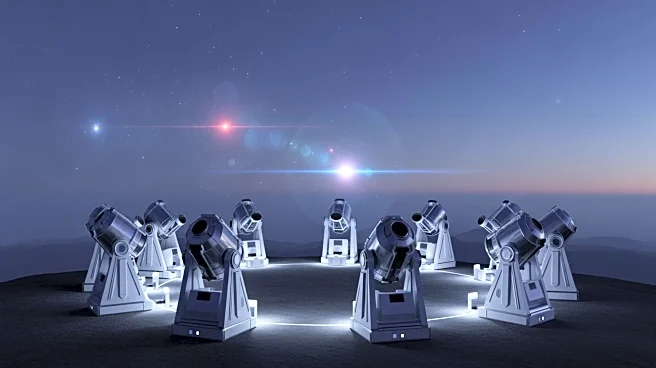
Astronomers using the CHARA Array telescope have captured high-resolution images of novae, revealing that these stellar explosions are more complex than previously thought. Traditionally viewed as simple, spherical fireballs, the new images show that novae involve
perpendicular jets of gas and delayed eruptions that affect entire star systems. This discovery was made possible by linking six telescopes using interferometry, allowing for detailed observation of the rapidly expanding debris fields of stars. The study focused on two novae in 2021: V1674 Herculis, a 'speed demon' that flashed and faded quickly, and V1405 Cassiopeiae, a 'slow burn' that lingered for months. The findings suggest that the gamma rays detected from these explosions are produced by internal collisions within the debris field.
Why It's Important?
The ability to observe the detailed structure of novae explosions provides significant insights into stellar evolution and the mechanics of these dramatic events. Understanding the complex dynamics of novae can help scientists connect the dots between nuclear reactions on a star's surface and the high-energy radiation observed from space. This research transforms novae from mere cosmic fireworks into laboratories for extreme physics, offering a better understanding of phenomena such as super-luminous supernovae and star mergers. The findings could have broader implications for astrophysics, potentially influencing theories about the lifecycle of stars and the formation of cosmic structures.
What's Next?
As telescopes become more advanced and response times improve, astronomers anticipate further discoveries in the field of stellar explosions. The CHARA Array's ability to capture detailed images of novae will likely lead to more studies on the interactions between binary stars and the resulting cosmic phenomena. Future research may focus on mapping the fluid dynamics and binary mechanics that drive these explosions, providing a deeper understanding of the universe's most energetic events. Continued observation and analysis will help refine existing models and potentially uncover new aspects of stellar behavior.