



What's Happening?
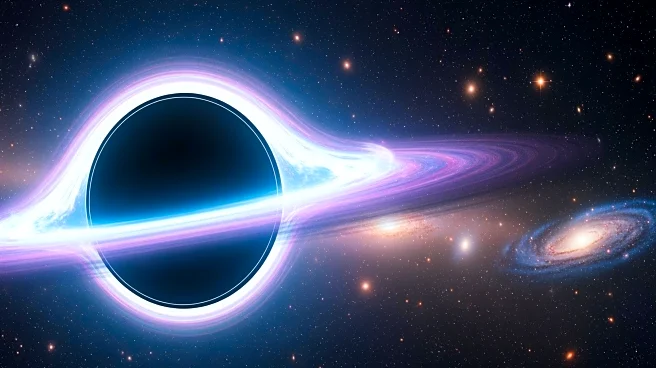
Astronomers have confirmed the existence of a runaway supermassive black hole, estimated to be about 10 million times more massive than the Sun, moving through space at approximately 3,000 times the speed of sound. Initially spotted in 2023 by a team
led by Yale University astronomer Pieter van Dokkum using the Hubble Space Telescope, the black hole was confirmed in 2025 with data from the James Webb Space Telescope. The Webb's advanced infrared instruments revealed displaced gas and shock waves surrounding the black hole, providing clear evidence of its ejection from its home galaxy. This discovery supports the theory that such black holes can be launched during violent galactic collisions.
Why It's Important?
The confirmation of a runaway supermassive black hole is a significant milestone in astrophysics, offering insights into the dynamics of galactic interactions. This discovery challenges existing models of galaxy formation and evolution, as it demonstrates that even the most massive cosmic structures can be displaced. Understanding the mechanisms behind such ejections can provide valuable information about the history and future of galaxies. Additionally, this finding highlights the capabilities of modern telescopes like the James Webb in uncovering previously theoretical phenomena, paving the way for further exploration of the universe's mysteries.
What's Next?
Future observations with upcoming instruments, such as NASA's Nancy Grace Roman Space Telescope, scheduled for launch in 2027, could provide more insights into runaway black holes. This telescope is designed to survey large areas of the sky in detail, potentially identifying more such phenomena and helping scientists understand the conditions that lead to these rare cosmic events. Continued research may reveal the number of galaxies involved in the original collision and the fate of the black hole's host galaxy, further enriching our understanding of cosmic dynamics.