







What's Happening?
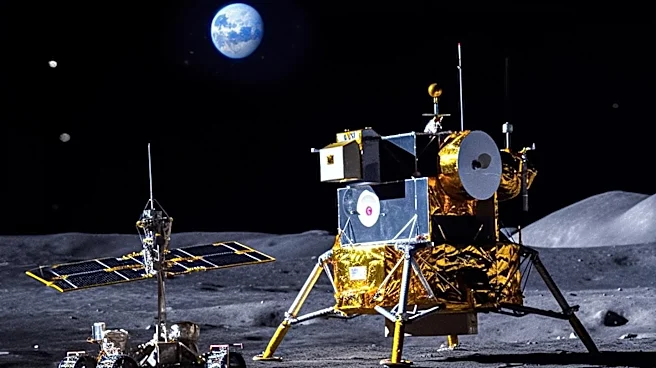
On September 20, 1970, the Soviet Union's Luna 16 moon probe successfully landed on the moon, collected a soil sample, and returned it to Earth. This mission marked the first time a robotic spacecraft achieved such a feat, demonstrating the Soviet Union's capability
to gather lunar samples without the need for crewed missions. The Luna 16 spacecraft made a soft landing in a lunar mare known as 'the Sea of Fertility' and retrieved 101 grams of lunar soil. The process involved drilling approximately 35 centimeters into the moon's surface, which took about seven minutes and was conducted entirely in darkness. The return capsule, carrying the lunar material, landed in the steppes of Kazakhstan on September 24, 1970, four days after its landing on the moon. This mission was the third lunar sample brought to Earth, following NASA's Apollo 11 and Apollo 12 missions.
Why It's Important?
The Luna 16 mission was a significant achievement for the Soviet Union, proving the viability of robotic lunar sample return missions. This success offered an alternative to the costly and risky crewed systems, especially after the Soviet Union had experienced major setbacks with its N-1 moon rocket program. The ability to robotically drill into the moon's surface to collect core samples, rather than just scooping surface material, expanded the scope of lunar exploration and scientific data collection. While the Soviet Union had already lost the 'Space Race' to the moon with NASA's Apollo 11 landing in 1969, Luna 16 allowed them to independently acquire lunar samples, contributing to their scientific understanding of the moon. This mission underscored the strategic importance of robotic capabilities in space exploration, offering a more economical and safer method for obtaining extraterrestrial samples.
What's Next?
While the immediate 'next' for Luna 16 was the analysis of the collected lunar samples, the broader implication of its success was the validation of robotic sample return technology. This achievement paved the way for future uncrewed missions designed to explore celestial bodies and bring back materials for study, reducing the inherent risks and costs associated with human spaceflight. The methodology employed by Luna 16, particularly its drilling capability and operation in darkness, provided valuable insights for subsequent robotic planetary missions. The success of Luna 16 likely influenced the development of more advanced robotic explorers and sample return systems, shaping the trajectory of uncrewed space exploration programs globally.
Beyond the Headlines
The Luna 16 mission highlights a pivotal moment in the 'Space Race,' showcasing the Soviet Union's technological prowess in robotic space exploration even after the U.S. had achieved crewed lunar landings. It underscored a philosophical divergence in space exploration strategies: the U.S. emphasized human presence, while the Soviet Union demonstrated the effectiveness of advanced robotics. This mission's success in operating in lunar darkness and drilling for samples pushed the boundaries of what was thought possible for robotic probes at the time. It also contributed to the broader scientific understanding of the moon by providing additional samples from a different lunar region, complementing those brought back by the Apollo missions. The long-term impact of Luna 16 lies in its contribution to the development of autonomous systems for space exploration, which continues to be a critical area of focus for space agencies worldwide.