







What's Happening?
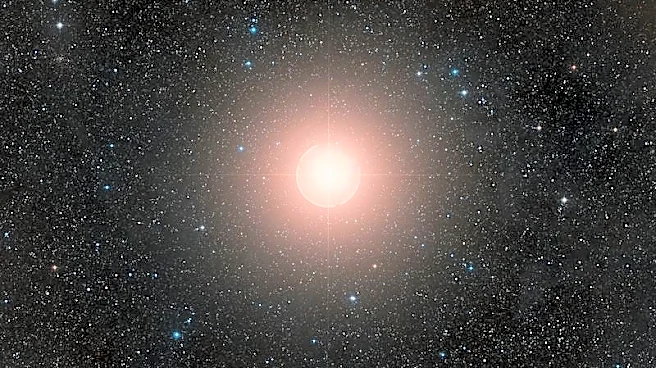
Astronomers have identified a new exoplanet, Beta Pictoris d, orbiting a star 63 light-years from Earth. This gas giant is significantly fainter than its neighbor, Beta Pictoris b, making it the faintest exoplanet ever directly imaged from the ground.
The discovery was made using the ERIS instrument on the European Southern Observatory's Very Large Telescope, revealing the planet's presence in archival images spanning 11 years. Beta Pictoris d orbits its star at an average distance of 26 astronomical units, potentially taking 91 years to complete one orbit. The planet is less massive than its counterparts, estimated at 2.4 Jupiter masses, and emits less infrared light due to its cooler temperature.
Why It's Important?
The discovery of Beta Pictoris d provides valuable insights into the formation and evolution of planetary systems. As the second system with more than two directly imaged planets, it offers a unique opportunity to study the dynamics and characteristics of exoplanets formed in the same environment. Understanding the differences in mass, temperature, and atmospheric composition among these planets can shed light on the processes that govern planetary development. Additionally, the presence of Beta Pictoris d may explain the unusual structures observed in the system's debris disk, suggesting gravitational influences shaping the material.
What's Next?
Future observations with advanced telescopes like the Extremely Large Telescope (ELT) could reveal even fainter and less massive planets within the Beta Pictoris system. Researchers anticipate that other systems with directly imaged giants may harbor smaller, hidden worlds. Continued study of Beta Pictoris d and its neighbors will enhance understanding of planetary formation and the gravitational interactions within multi-planet systems.
Beyond the Headlines
The discovery highlights the potential for uncovering hidden exoplanets through direct imaging, a challenging method due to the brightness of host stars. The use of instruments like the James Webb Space Telescope, which detected Beta Pictoris d independently, underscores the importance of diverse observational techniques in confirming planetary signals. This approach allows astronomers to distinguish planets from surrounding debris, providing clearer insights into planetary atmospheres and compositions.