
What's Happening?
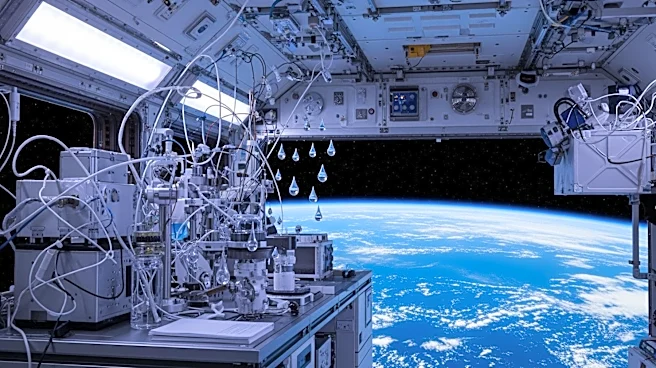
NASA has completed its Atmospheric Waves Experiment (AWE) mission, which was conducted aboard the International Space Station (ISS) to study how Earth's storms affect space weather. The mission, which lasted
over two years, focused on atmospheric gravity waves—oscillations in the atmosphere caused by events like hurricanes and tornadoes. These waves were detected through the atmosphere's infrared emissions, known as airglow. The AWE instrument captured over 80 million nighttime images, providing insights into how different storms generate varying atmospheric waves. This data is crucial as these waves can alter the density of plasma in the upper atmosphere, impacting satellite communications and navigation systems.
Why It's Important?
The findings from the AWE mission are significant for understanding the interaction between Earth's weather systems and space weather. Atmospheric gravity waves can disrupt radio signals and reduce the accuracy of satellite-based systems, which are vital for global communications and navigation. By identifying the types of waves that have the most impact, NASA can improve the reliability of these systems. The mission's data will be publicly available, offering researchers valuable information to further study and mitigate the effects of space weather on technological infrastructure.
What's Next?
Following the conclusion of the AWE mission, the instrument will be removed from the ISS to make way for the CLARREO Pathfinder, which will measure sunlight reflected from Earth and the Moon with greater precision. The data collected by AWE will continue to be analyzed and is expected to contribute to future research on atmospheric and space weather interactions. This ongoing research is crucial for developing strategies to protect satellites and other space-based technologies from the adverse effects of space weather.