




What's Happening?
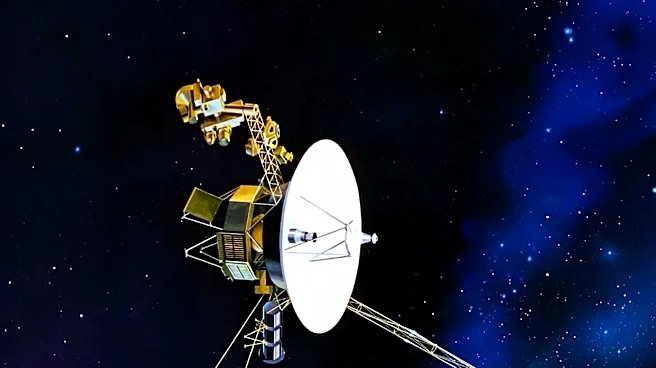
NASA engineers at the Jet Propulsion Laboratory have successfully implemented a power-saving strategy, nicknamed the 'Big Bang,' to extend the operational life of the Voyager 2 spacecraft. Launched nearly 50 years ago, Voyager 2 relies on radioisotope
thermoelectric generators, which convert heat from decaying plutonium into electricity. As the plutonium decays, the available power steadily declines by about 4 watts annually. To counteract this, the team simultaneously shut down certain powered devices and replaced them with alternatives requiring less electricity, while ensuring the spacecraft remained warm enough to function. This intervention is expected to allow Voyager 2's three remaining science instruments to continue operating for at least one additional year, preventing the need to shut down another instrument before the end of 2026.
Why It's Important?
The Voyager 2 mission, along with its twin Voyager 1, represents humanity's farthest reach into interstellar space, providing invaluable data about the heliosphere and the regions beyond. Extending its operational life, even by a single year, means continued collection of critical scientific data from a unique vantage point. This data helps scientists understand the boundaries of our solar system and the properties of interstellar space, contributing to fundamental astrophysics and planetary science. The innovative power management technique demonstrates NASA's commitment to maximizing the scientific return from its long-duration missions, showcasing engineering ingenuity in the face of aging technology and dwindling resources. The success with Voyager 2 also sets a precedent for applying similar strategies to Voyager 1, further prolonging the scientific output of both historic probes.
What's Next?
Following the successful implementation of the 'Big Bang' power-saving strategy on Voyager 2, the mission team plans to apply the same technique to Voyager 1 in the coming months. Voyager 1 is even farther from Earth than Voyager 2, making its continued operation equally, if not more, critical for interstellar research. Engineers will need to carefully manage the power budget for both spacecraft as their radioisotope thermoelectric generators continue to degrade. The ongoing challenge will be to balance scientific data collection with the need to maintain essential spacecraft systems, including heating, to ensure their longevity in the extreme cold of deep space. Future decisions will likely involve further prioritization of instruments and systems as power levels continue to decrease.
Beyond the Headlines
The efforts to keep Voyager 2 alive highlight the remarkable longevity and resilience of these pioneering spacecraft, which have far exceeded their original design lives. This mission embodies humanity's enduring curiosity and drive for exploration, pushing the boundaries of what is technologically possible. The 'Big Bang' operation is not just an engineering feat; it's a testament to the dedication of the teams who have managed these missions for decades, adapting to unforeseen challenges in the harsh environment of deep space. The data from Voyager 2 continues to reshape our understanding of the cosmos, offering insights into regions no other spacecraft has reached. Its extended life ensures that this legacy of discovery will continue, inspiring future generations of scientists and engineers.