







What's Happening?
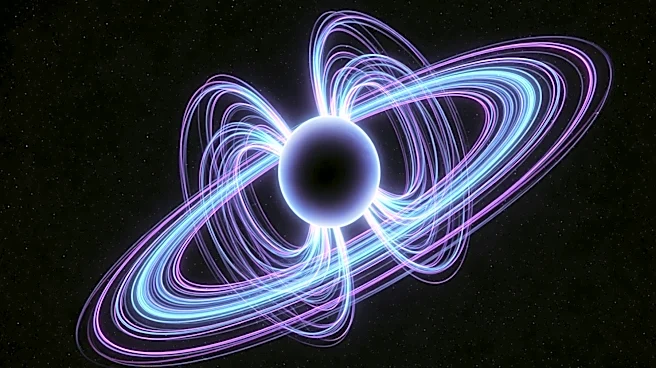
Astronomers have discovered that neutron stars at the heart of pulsars can emit radio signals from regions beyond their magnetic poles, challenging decades-old theories. This finding, based on observations of around 200 millisecond pulsars, suggests that radio waves
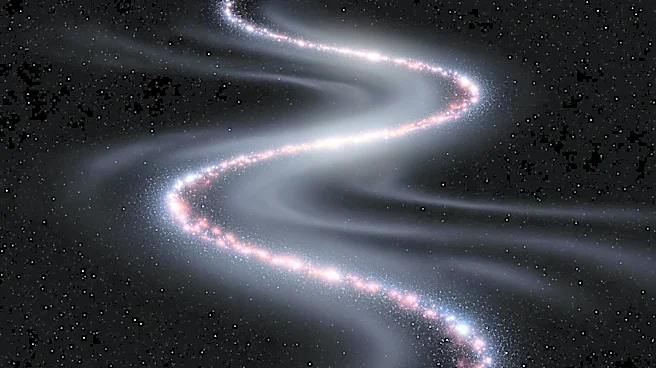
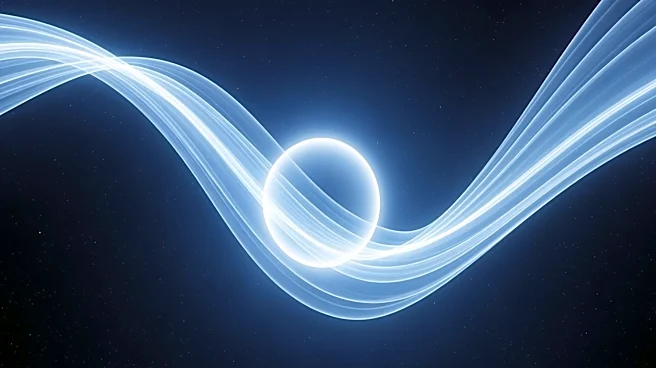
can emanate from swirling 'current sheets' of charged particles, not just from the poles. The study indicates that these signals align with gamma-ray emissions, suggesting a shared origin. This discovery could redefine our understanding of pulsar emissions and their use as cosmic clocks.
Why It's Important?
The ability of pulsars to emit radio waves from non-polar regions expands the potential for detecting these cosmic phenomena, as they do not need to be perfectly aligned with Earth. This could enhance the use of pulsars in measuring gravitational waves and other cosmic phenomena. The findings also suggest a more complex structure of pulsars, prompting a reevaluation of their role in the universe. Understanding these emissions is crucial for astrophysics, as pulsars serve as precise tools for studying the cosmos.
What's Next?
Further research will focus on understanding how radio pulses are generated far from neutron stars and their turbulent environments. This could involve more detailed observations and modeling to explore the mechanisms behind these emissions. The findings may lead to new methods for detecting and studying pulsars, potentially uncovering more about their structure and behavior. As research continues, this could lead to a deeper understanding of the universe's most extreme objects and their impact on cosmic phenomena.