



What's Happening?
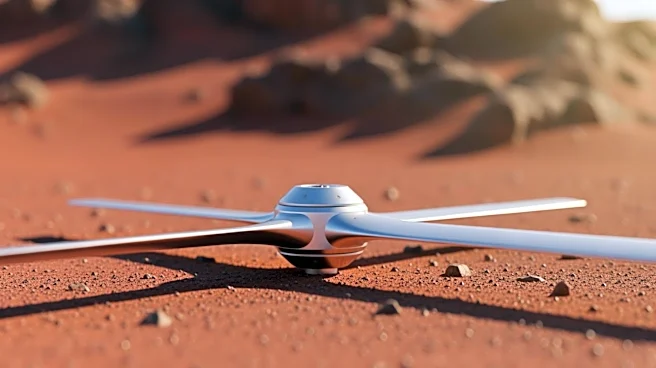
Five years ago, on April 19, 2021, NASA's Ingenuity helicopter achieved a historic milestone by conducting the first powered flight on Mars. The flight lasted 39 seconds, during which the helicopter rose vertically to a height of 3 meters, hovered briefly,
and then landed. This achievement is often compared to the Wright brothers' first flight on Earth due to its groundbreaking nature. Ingenuity's success demonstrated the feasibility of aerodynamic flight on Mars, a planet with an atmosphere 100-160 times less dense than Earth's. The helicopter was developed by AeroVironment in collaboration with NASA, overcoming significant challenges such as the thin Martian atmosphere and the need for autonomous navigation due to communication delays with Earth.
Why It's Important?
The successful flight of Ingenuity represents a significant advancement in space exploration technology, proving that rotorcraft can operate on Mars. This opens new possibilities for future missions, allowing for aerial exploration of the Martian surface, which could provide valuable data and insights that are not possible with traditional rovers. The ability to fly on Mars could enhance scientific research by reaching areas that are otherwise inaccessible, thus expanding our understanding of the planet's geology and climate. Ingenuity's success also paves the way for future missions to other celestial bodies, such as Saturn's moon Titan, where similar technology could be employed.
What's Next?
Following Ingenuity's success, NASA and other space agencies are likely to continue exploring the use of helicopters in planetary exploration. The Dragonfly mission, a multirotor drone set to explore Titan, is scheduled to launch in 2028, with arrival expected in 2036. While NASA currently has no immediate plans to send new helicopters to Mars, the demonstrated efficiency of aerodynamic flight suggests that future missions could incorporate similar technology. This could lead to more comprehensive exploration of Mars and potentially other planets with suitable atmospheres for flight.
Beyond the Headlines
Ingenuity's mission highlights the potential for innovative engineering solutions in overcoming the challenges of space exploration. The helicopter's design, which includes a dual-rotor system and autonomous navigation capabilities, showcases the ingenuity required to adapt to the unique conditions of other planets. The mission also underscores the importance of international collaboration and technological advancement in expanding human presence beyond Earth. As space exploration continues to evolve, the lessons learned from Ingenuity's mission will likely inform the development of future technologies and strategies for exploring the solar system.