


What's Happening?
The Perseids meteor shower is anticipated to reach its peak activity on the night between August 12th and 13th, 2026. This celestial event is expected to offer up to 100 meteors per hour under optimal dark sky conditions. A significant factor enhancing
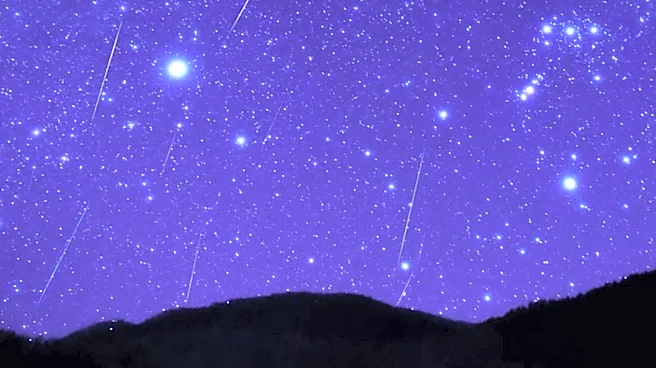
the viewing experience for 2026 is the coincidence of the meteor shower's peak with the New Moon on August 12th. This alignment means that moonlight will not interfere with observations, ensuring an exceptionally dark sky. Such conditions are ideal for spotting even fainter meteors, making the 2026 Perseids shower a potentially spectacular event for stargazers. The Perseids are not actual stars but meteoroids, which are small rock fragments that burn up upon entering Earth's atmosphere, creating visible streaks of light. The broader viewing window for the Perseids typically runs from July 17th to August 24th.
Why It's Important?
The Perseids meteor shower is one of the most anticipated annual astronomical events, drawing significant public interest in stargazing and amateur astronomy. The favorable conditions in 2026, particularly the absence of moonlight interference due to the New Moon, could lead to increased public engagement with science and astronomy. This event provides an opportunity for educational institutions and observatories to host public viewing events, fostering scientific curiosity and appreciation for natural phenomena. For tourism in areas with low light pollution, such as national parks or designated dark sky preserves, the Perseids peak can attract visitors seeking optimal viewing experiences, potentially boosting local economies. The clarity of the event also offers valuable data collection opportunities for professional astronomers studying meteoroid streams and atmospheric entry phenomena.
What's Next?
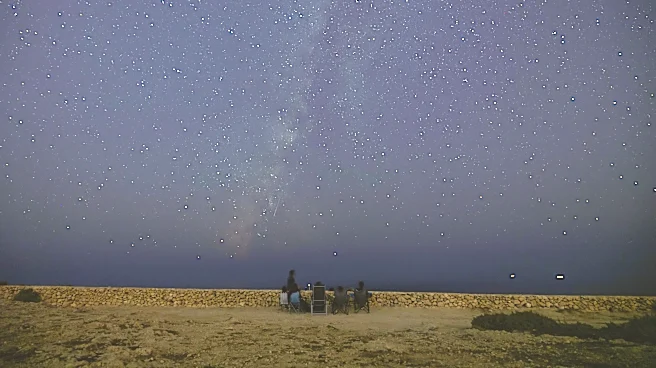
As the peak approaches in August 2026, astronomy clubs, observatories, and national parks across the U.S. are likely to announce special viewing events and educational programs. These events will aim to guide the public on how to best observe the meteor shower, including recommendations for finding dark sky locations and tips for optimal viewing without specialized equipment. Media outlets will likely provide coverage leading up to the event, offering guidance and generating public excitement. Individuals interested in observing the Perseids should plan to find locations away from city lights, allow their eyes to adjust to the darkness for at least 30 minutes, and lie flat on their backs with their feet facing east to take in as much of the sky as possible.
Beyond the Headlines
The Perseids meteor shower, with its consistent annual appearance, serves as a powerful reminder of Earth's journey through space and its interaction with cosmic debris. Beyond the visual spectacle, these events contribute to our understanding of the composition of comets and the early solar system, as the meteoroids are remnants from Comet Swift-Tuttle. The increasing awareness and appreciation for dark skies, partly fueled by events like the Perseids, also highlight growing concerns about light pollution. Efforts to preserve dark sky areas are gaining momentum, not just for astronomical observation but also for ecological reasons, as artificial light at night can disrupt wildlife and human circadian rhythms. The 2026 Perseids, with its ideal viewing conditions, could further galvanize public support for dark sky conservation initiatives.