






What's Happening?
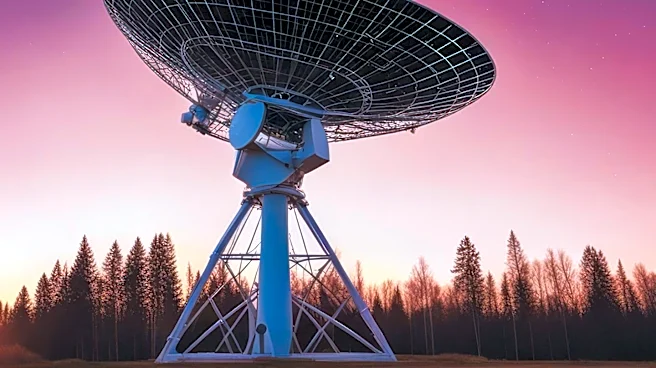
An international team of astronomers, utilizing South Africa’s MeerKAT radio telescope array, has successfully detected variable radio bursts originating directly from Beta Pictoris b, a massive gas giant exoplanet located approximately 63 light-years
away. This marks the first time a radio signal has been confirmed as coming from a single exoplanet, rather than from an entire star system. The discovery is significant because it allows scientists to study the magnetic fields of exoplanets, similar to how Jupiter is the strongest auroral radio source in our Solar System. The team targeted Beta Pictoris b because its orbiting star, Beta Pictoris, is magnetically quiet, which enabled them to isolate the planet's specific radio signal. The physics behind these signals is believed to be the same mechanism that powers aurora displays on planets within our own Solar System, where energetic, charged particles interact with a planet's magnetic field.
Why It's Important?
This landmark discovery is crucial for the search for habitable worlds beyond our Solar System. Planetary magnetic fields play a vital role in protecting atmospheres from being stripped away by stellar winds, much like Earth's magnetic field shields us from the Sun's power. Understanding these magnetic fields is therefore essential in determining a planet's potential for sustaining life. By detecting radio emissions, astronomers can now calculate the strength of an exoplanet's magnetic field, as demonstrated with Beta Pictoris b, which has a magnetic field thousands of times stronger than Earth's. This new method provides a unique way to learn more about the types of planets orbiting distant stars and assess their habitability, moving beyond traditional methods of exoplanet characterization.
What's Next?
The success of this study opens new avenues for exoplanet science. With more powerful radio observatories expected in the future, astronomers can apply the lessons learned from this detection to target other gas giant exoplanets. This could lead to a broader understanding of exoplanetary magnetic fields and their role in planetary evolution and habitability. The ability to directly detect and characterize these magnetic fields will refine models of exoplanet atmospheres and their interaction with host stars. Future research will likely focus on identifying more exoplanets with detectable radio emissions and correlating these signals with other planetary characteristics to build a comprehensive picture of exoplanet environments and their potential to harbor life.
Beyond the Headlines
The detection of radio signals from Beta Pictoris b has profound implications beyond simply identifying exoplanets. It represents a significant step in understanding the fundamental processes that govern planetary systems across the galaxy. The ability to measure magnetic field strength remotely could help differentiate between various types of exoplanets and their evolutionary paths. This research also highlights the continuous advancement of astronomical instrumentation and techniques, pushing the boundaries of what can be observed and understood about the cosmos. While the discovery is not indicative of alien life, it provides a critical tool in the long-term quest to find where life might exist, by identifying planets that possess a key ingredient for habitability: a protective magnetic field.