







What's Happening?
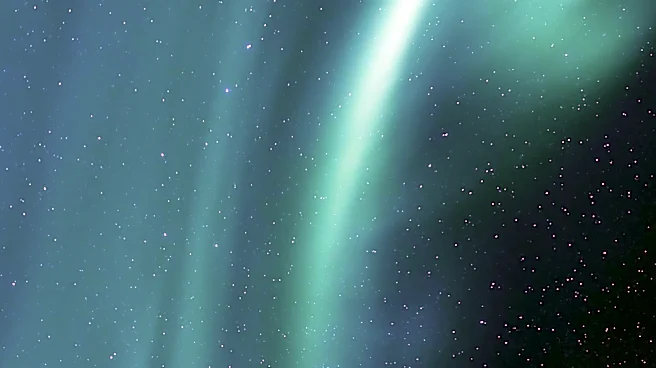
A geomagnetic storm rated as G1 by the Space Weather Prediction Center is expected to make the northern lights visible in 19 U.S. states, including Vermont, on the night of June 29, 2026. The storm's minor intensity suggests that the aurora may be visible at high
latitudes, particularly in the northern tier of the U.S., such as northern Michigan and Maine. The National Oceanic and Atmospheric Administration (NOAA) indicates that the best chance to see the lights will be in states like Washington, Idaho, Montana, North Dakota, South Dakota, Minnesota, Wisconsin, Michigan, and Maine. However, there is also a possibility for visibility in Oregon, Wyoming, Nebraska, Iowa, Illinois, Indiana, Ohio, New York, Vermont, and New Hampshire. The optimal time for viewing the northern lights is typically between 10 p.m. and 2 a.m., and the National Weather Service forecasts mostly clear skies, which could enhance visibility.
Why It's Important?
The potential visibility of the northern lights across a significant portion of the U.S. is a rare and exciting event for skywatchers and the general public. Such celestial displays can boost local tourism as people travel to areas with optimal viewing conditions. Additionally, the event highlights the importance of space weather monitoring and its impact on Earth. Geomagnetic storms, while often harmless, can affect satellite operations, GPS systems, and power grids, underscoring the need for continued research and preparedness in managing space weather phenomena. The event also provides educational opportunities for schools and science enthusiasts to engage with astronomy and atmospheric sciences.
What's Next?
If the geomagnetic storm intensifies, the northern lights could become visible further south, potentially reaching states like Illinois and Oregon. Observers are encouraged to monitor aurora forecasts through various online platforms to maximize their chances of witnessing the event. Local communities and parks may organize viewing events, providing safe and dark locations for optimal viewing. Additionally, the scientific community will continue to monitor the storm's progression and its effects on Earth's magnetosphere, contributing to a better understanding of space weather dynamics.