








What's Happening?
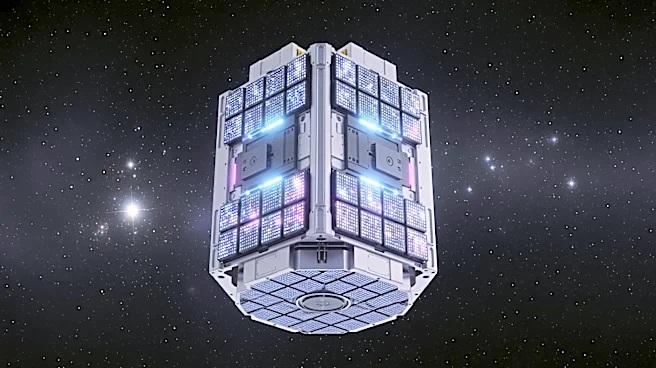
NASA has developed a new type of gamma-ray sensor called AstroPix, which will be part of a robotic arm demonstration on the upcoming Fly Foundational Robots mission, set to launch in late 2027. Gamma rays, the highest-energy form of light, are observed
from events such as lightning, solar flares, and cosmic collisions. AstroPix sensors are designed to measure gamma rays between 20,000 and 700,000 electron volts, filling a gap in sensitivity for energies between 500,000 to 1 million electron volts. This range is crucial for observing gamma-ray bursts and the glow from massive galaxies powered by black holes. The AstroPix technology aims to improve observations of these cosmic phenomena, enhancing understanding of the processes that create them. The Fly Foundational Robots mission will host the AstroPix Satellite Technology Demonstration Payload, which will be repositioned by a robotic arm during flight, collecting data in orbit.
Why It's Important?
The development of AstroPix gamma-ray detectors is significant for advancing space observation capabilities. By bridging the sensitivity gap in gamma-ray detection, NASA can better study high-energy cosmic events, such as gamma-ray bursts and active galaxies. This improved observation capability could lead to new insights into the universe's most energetic phenomena, potentially impacting astrophysics research and our understanding of cosmic processes. The integration of AstroPix into the Fly Foundational Robots mission also demonstrates NASA's commitment to innovative technology demonstrations, which can lead to more cost-effective upgrades and improvements to space instruments.
What's Next?
The AstroPix team is working to deliver their hardware by September, with integration into the Fly Foundational Robots payload scheduled before final spacecraft integration. The mission will demonstrate robotic changeout of payloads in orbit, allowing for upgrades to satellites and space instruments at reduced costs. This technology demonstration could pave the way for future missions that utilize similar robotic servicing capabilities, enhancing the longevity and functionality of space assets.
Beyond the Headlines
The AstroPix technology represents a significant step in the evolution of space instrumentation, potentially influencing future mission designs and strategies. The ability to perform in-orbit upgrades and servicing could lead to more sustainable and adaptable space exploration efforts, reducing the need for entirely new missions and enabling continuous scientific advancements.