
What's Happening?
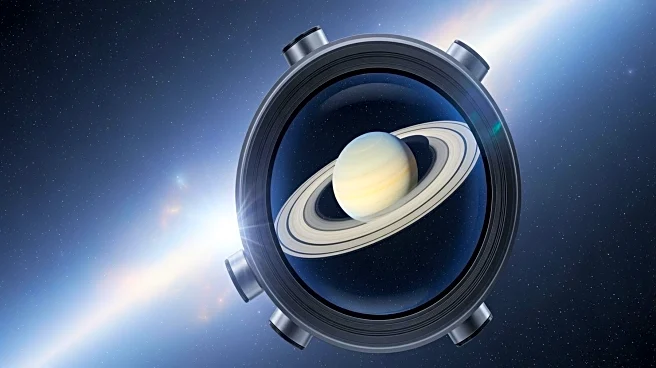
NASA's Hubble Space Telescope and the James Webb Space Telescope have collaborated to provide the most comprehensive view of Saturn to date. This joint effort combines Hubble's optical observations with Webb's infrared capabilities, offering a detailed
look at Saturn's atmospheric structure and dynamic processes. The Hubble Space Telescope, operational for over three decades, has been instrumental in building a record of Saturn's evolving atmosphere through programs like OPAL. The James Webb Space Telescope, known for its advanced infrared capabilities, adds a new dimension to these observations, allowing scientists to 'slice' through Saturn's atmosphere at multiple altitudes. This collaboration has revealed new insights into Saturn's atmospheric features, including its iconic hexagon-shaped jet stream and various storms across its hemispheres.
Why It's Important?
The collaboration between Hubble and Webb telescopes is significant as it enhances our understanding of Saturn's atmospheric dynamics, which can provide insights into fluid dynamics under extreme conditions. This partnership not only extends the legacy of Hubble's observations but also demonstrates the capabilities of the James Webb Space Telescope in studying planetary atmospheres. The findings could have broader implications for understanding atmospheric processes on other gas giants and contribute to the field of planetary science. The ability to observe Saturn's atmosphere in such detail helps scientists track changes over time, offering a natural laboratory for studying atmospheric phenomena.
What's Next?
As Saturn transitions into southern spring and later southern summer, the telescopes will have progressively better views of the southern hemisphere. This ongoing observation will continue to build on the existing record of Saturn's atmospheric changes, providing valuable data for future research. The collaboration between Hubble and Webb is expected to continue, offering new opportunities to study other celestial bodies and phenomena in our solar system and beyond.