



What's Happening?
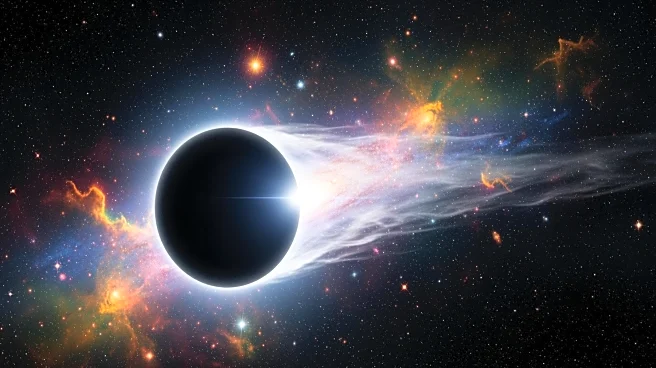
Astronomers have confirmed the existence of a runaway supermassive black hole, named RBH-1, which has been ejected from its host galaxy. This black hole, at least 10 million times the mass of the Sun, is traveling at a speed of 954 kilometers per second,
equivalent to 0.32 percent of the speed of light. The discovery was made using the James Webb Space Telescope's (JWST) near-infrared NIRSpec instrument, led by astrophysicist Pieter van Dokkum of Yale University. The black hole is moving through the circumgalactic medium, leaving a trail of star formation extending 200,000 light-years behind it. The researchers propose that the black hole's ejection was likely due to a gravitational recoil from a merger between two supermassive black holes, a phenomenon predicted by theories of gravitational-wave recoil or multi-body ejection from galactic nuclei.
Why It's Important?
This discovery is significant as it provides empirical validation of a long-standing prediction that supermassive black holes can be ejected from their host galaxies. The confirmation of RBH-1 as a runaway supermassive black hole offers insights into the dynamics of galaxy mergers and the behavior of black holes. It highlights the potential for such black holes to wander intergalactic space, influencing the formation and evolution of galaxies. The findings also underscore the capabilities of the JWST in observing and confirming complex cosmic phenomena, advancing our understanding of the universe's structure and the role of black holes in shaping it.
What's Next?
Future research will likely focus on identifying more runaway supermassive black holes and understanding the conditions that lead to their ejection. Astronomers may use simulations and further observations to explore the frequency and impact of such events on galaxy evolution. The study of RBH-1 could also inspire new theoretical models to explain the interactions and mergers of supermassive black holes, potentially leading to discoveries about gravitational waves and their effects on cosmic structures.
Beyond the Headlines
The confirmation of RBH-1 as a runaway supermassive black hole raises questions about the fate of galaxies that lose their central black holes. It may lead to a reevaluation of how galaxies maintain their structure and the role of black holes in regulating star formation and galactic dynamics. Additionally, the discovery could have implications for the search for gravitational waves, as the ejection of black holes is linked to gravitational-wave recoil, offering a new avenue for studying these elusive ripples in spacetime.