


What's Happening?
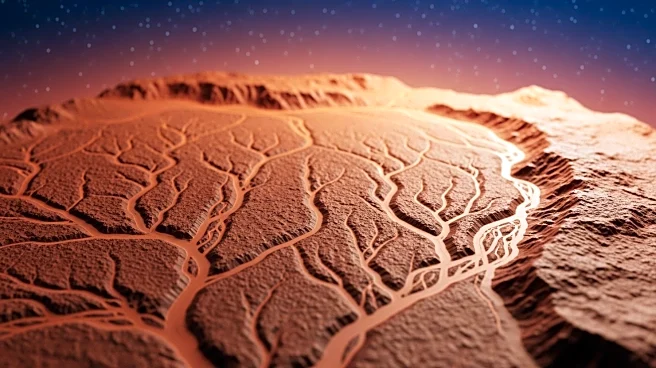
Scientists have successfully mapped large, continent-sized river drainage systems on Mars for the first time, revealing that the planet once had extensive flowing water systems. This discovery, based on data from Mars orbiters and ancient maps, suggests
that Mars had organized river networks similar to those on Earth. The research, led by Abdallah Zaki from the University of Austin, identified 16 large drainage basins on Mars, each covering at least 38,610 square miles. These basins, which carried significant amounts of sediment, are believed to have been favorable environments for life due to prolonged water-rock interactions. The findings, published in the Proceedings of the National Academy of Sciences, could guide future missions in the search for chemical signatures of life on Mars.
Why It's Important?
The mapping of ancient river basins on Mars is a significant step in understanding the planet's history and its potential to have supported life. These findings provide crucial insights into the planet's geological past and suggest that Mars once had conditions conducive to life. The large river systems, which carried water and nutrients over long distances, may have preserved chemical signatures indicative of past life. This research not only enhances our understanding of Mars but also aids in selecting strategic locations for future missions aimed at finding evidence of life. The implications extend to planetary science and astrobiology, as they offer a new perspective on the potential habitability of Mars.
What's Next?
The new map of Mars' river basins will serve as a guide for future missions, particularly those focused on searching for signs of past life. Scientists will likely prioritize these basins as targets for exploration, as they may harbor preserved evidence of ancient life. Future missions could involve detailed analysis of sediment samples from these basins to detect chemical signatures of life. The research underscores the importance of selecting the right locations for exploration to maximize the chances of discovering evidence of past life on Mars.