
What's Happening?
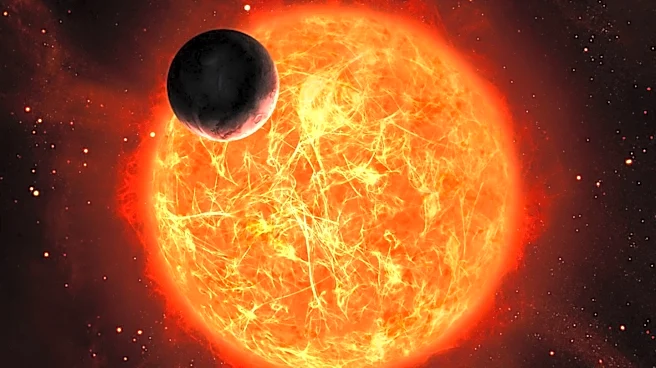
Astronomers have potentially discovered the first exomoon outside our solar system in the star system CD-35 2722, located approximately 73 light-years away. This system includes a brown dwarf, a type of
'failed star' that lacks sufficient mass to initiate hydrogen fusion. The newly identified object orbits this brown dwarf, rather than a planet, challenging traditional definitions of moons and planets. The research, led by Kevin Hoy from Universidad Diego Portales and the Millennium Nucleus of Young Exoplanets and their Moons in Chile, suggests that this object, while moon-like, is massive enough to be considered a planet. The findings were published in the journal Nature.
Why It's Important?
The discovery of this potential exomoon is significant as it challenges existing astronomical classifications and expands our understanding of celestial bodies. It highlights the complexity of defining moons and planets in systems unlike our own. This finding could lead to a reevaluation of how we categorize celestial bodies, influencing future astronomical research and exploration. The study also underscores the capabilities of modern telescopes and the importance of continued investment in space observation technologies.
What's Next?
Further observations and studies are needed to confirm the classification of this object as an exomoon. The upcoming Extremely Large Telescope (ELT) in Chile could play a crucial role in this research, providing more detailed observations. The scientific community will likely engage in discussions to refine the definitions of moons and planets, potentially leading to new criteria for classification. This discovery may also prompt additional searches for exomoons in other star systems, expanding our knowledge of the universe.