




What's Happening?
Colorado Governor Jared Polis has formally requested nearly $27 million in federal aid from the Trump administration and the Federal Emergency Management Agency (FEMA) to assist with recovery efforts following devastating floods in southern Colorado.
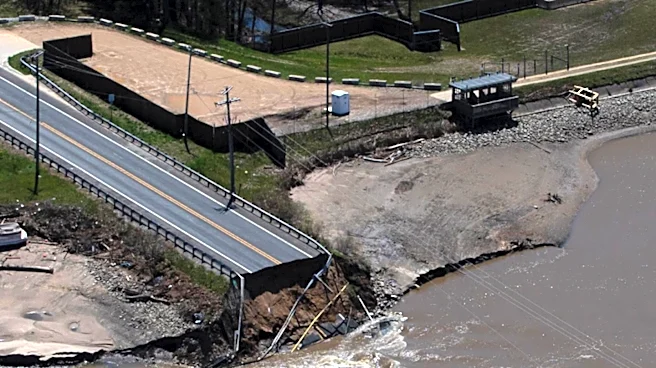
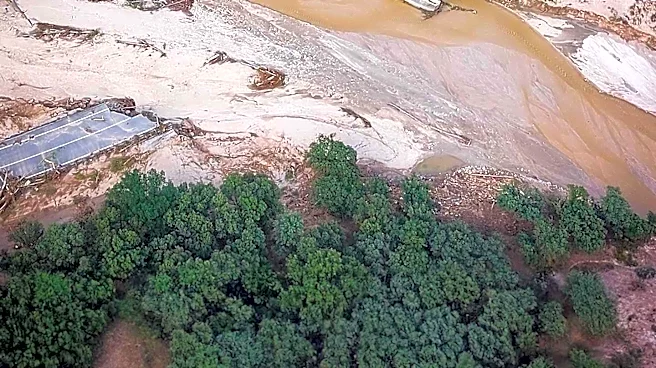
The request, made on Saturday, seeks an expedited major disaster declaration to secure public assistance funding for repairing damaged public infrastructure such as roads, bridges, public utilities, and parks. Additionally, Governor Polis requested hazard mitigation grant funding to support initiatives aimed at reducing future flood damage. The initial assessment of damages, validated by state officials and FEMA, totals $26.98 million across Archuleta and Rio Grande counties. This figure includes approximately $10.6 million for local roads, bridges, and culverts, $2.44 million for public utilities, and $8.59 million for parks and recreation facilities. The request also covers debris removal and $4.16 million for emergency protective measures. Governor Polis emphasized that the documented damage surpasses the capacity of state and local resources alone, urging President Trump to approve the request swiftly. The state continues to assess the full extent of the damage, with additional costs and affected counties potentially being added to the request as assessments are completed. The Federal Highway Administration has already approved $6.5 million in quick-release funds for emergency repairs to damaged highways.
Why It's Important?
This request for federal aid is crucial for the affected communities in southern Colorado, as it seeks to alleviate the financial burden of extensive flood damage on local and state governments. The funding, if approved, would enable the repair and rebuilding of essential public infrastructure, which is vital for the daily lives and economic activities of residents. Without federal assistance, the recovery process would be significantly slower and more challenging, potentially leading to prolonged disruptions in services and economic hardship. The hazard mitigation grants are particularly important as they aim to implement measures that will protect these communities from future flood events, thereby reducing long-term risks and costs. The approval of this declaration would demonstrate federal support for states grappling with natural disasters, setting a precedent for how the Trump administration responds to such emergencies. The potential denial, however, could leave Colorado to bear a larger share of the recovery costs, impacting its budget and ability to fully restore affected areas. The request also highlights the ongoing vulnerability of infrastructure to extreme weather events and the necessity of robust federal-state partnerships in disaster response.
What's Next?
The immediate next step involves President Trump's review and decision on Governor Polis's request for a major disaster declaration. There is no specific timeline for the President to respond, creating a period of uncertainty for Colorado officials and affected communities. If approved, FEMA will likely match 75% of the eligible costs for repairs and mitigation efforts. State officials will continue their damage assessments in other impacted counties, and as these assessments are finalized, additional costs and counties may be added to the federal aid request. The Southern Ute tribe, whose lands were also affected, will pursue its own separate FEMA assistance. Meanwhile, emergency repair work on highways, supported by the $6.5 million in quick-release funds from the Federal Highway Administration, is expected to continue. The region is also bracing for more heavy rain and severe flooding, which could exacerbate existing damage and necessitate further aid requests. The state hopes for a prompt approval to avoid delays in the extensive repair work, which is anticipated to take many months.
Beyond the Headlines
The request for federal aid extends beyond immediate financial relief, touching upon broader themes of climate resilience and intergovernmental cooperation. The recurring nature of severe flooding in Colorado, with this year's event being particularly devastating and following a similar incident in 2025, underscores the increasing challenges posed by extreme weather. The previous denial of federal funding for Colorado's 2025 floods by President Trump adds a layer of political uncertainty to the current request, highlighting potential inconsistencies in federal disaster response. This situation could influence future state-federal relations regarding disaster preparedness and recovery. Furthermore, the emphasis on hazard mitigation funding reflects a growing recognition of the need to invest in preventative measures rather than solely reactive responses. This proactive approach is critical for communities in vulnerable regions to adapt to changing climate patterns and reduce long-term economic and social impacts. The independent pursuit of FEMA assistance by the Southern Ute tribe also points to the complex dynamics of disaster relief for tribal nations, often requiring separate processes and considerations.