
What's Happening?
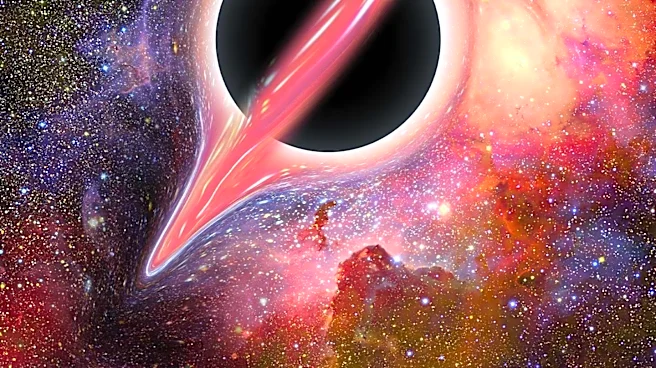
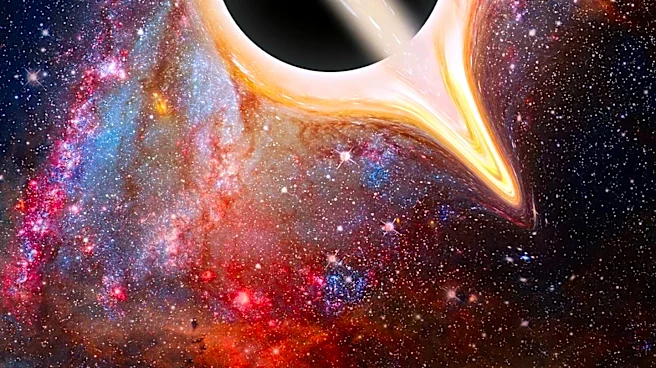
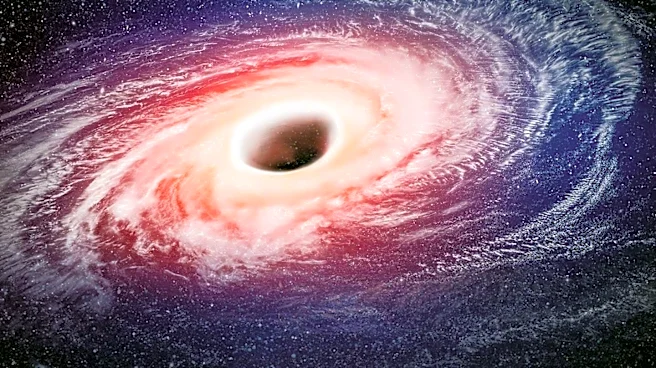
Astronomers have potentially identified a supermassive black hole that has wandered to the edge of its galaxy, a significant departure from the typical location at a galaxy's center. This discovery was made possible by observing a tidal disruption event,
where a black hole consumes a star, emitting a distinct light pattern. The black hole is located over 30,000 light-years from its host galaxy's core, providing evidence for the existence of 'wandering' black holes. This finding, published in the Astrophysical Journal Letters, could offer insights into the history and evolution of galaxies.
Why It's Important?
The discovery of a wandering supermassive black hole challenges existing theories about the behavior and location of these celestial objects. It suggests that galaxies may have more complex histories involving mergers and interactions that can displace black holes. Understanding the distribution and movement of black holes can provide valuable information about galaxy formation and evolution. This research could lead to new models of galactic dynamics and influence future astronomical studies.
What's Next?
Researchers are likely to continue studying this black hole and others like it to gather more data on their behavior and impact on their host galaxies. Further observations using advanced telescopes could reveal additional wandering black holes, helping to refine theories about their origins and movements. The development of new technologies and methods for detecting these objects will be crucial in advancing our understanding of the universe.