







What's Happening?
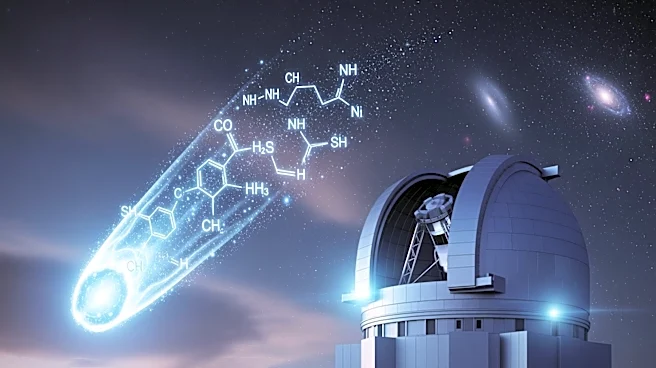
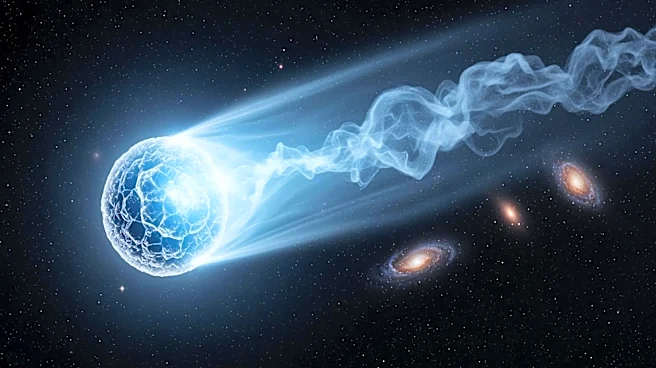
The interstellar comet 3I/ATLAS, which originated from outside our solar system, is now leaving after a brief visit. Using the James Webb Space Telescope, researchers at Caltech have detected methane emissions from the comet as it exits. This comet, over
a kilometer wide, has been traveling through the galaxy for at least a billion years. The study of its mid-infrared signatures has provided insights into the distant environment where it formed. The comet's surface, irradiated by cosmic rays, began emitting methane as it was warmed by the sun, revealing its inner icy layers.
Why It's Important?
The study of 3I/ATLAS offers a rare opportunity to understand the composition and formation of celestial bodies from other planetary systems. By analyzing the chemical compounds of the comet, scientists can gain insights into the conditions of its origin, which differ from those in our solar system. This research enhances our understanding of planetary formation and the diversity of cosmic materials. The findings could have implications for the study of other interstellar objects and the potential for discovering new materials and compounds.
What's Next?
The James Webb Space Telescope is scheduled to observe 3I/ATLAS again in the spring, although the comet is becoming increasingly difficult to study as it moves past Jupiter. Future observations will focus on the dust composition of the comet, which will be detailed in a forthcoming paper. Continued research on interstellar objects like 3I/ATLAS will help refine our understanding of the universe and the processes that govern planetary formation.