
What's Happening?
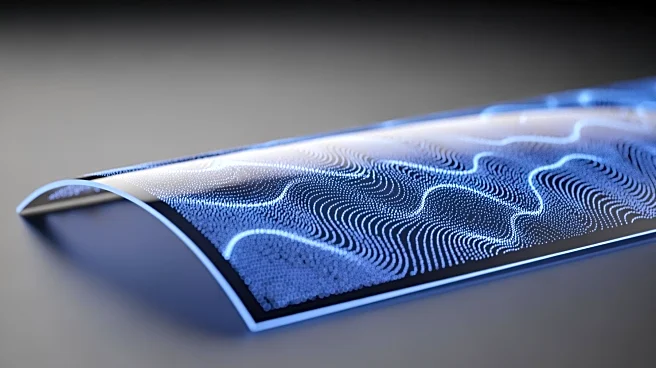
Researchers have developed a new approach to enhance the efficiency and color stability of flexible organic light-emitting diodes (OLEDs) using nanotextured light modulation. By incorporating nanoporous
films (NPFs) and optical clear resin (OCR) layers, the team achieved a 370% increase in external quantum efficiency (EQE) and improved angular color stability. The NPFs, applied to top-emitting OLEDs (TEOLEDs), enhance light extraction and reduce internal reflection, leading to more uniform emission profiles. This advancement is significant for the evolution of wearable display technology, offering potential improvements in device performance and energy efficiency.
Why It's Important?
The development of more efficient and stable flexible OLEDs has significant implications for the wearable technology market. Enhanced EQE and color stability can lead to longer-lasting, more vibrant displays, which are crucial for consumer electronics. This innovation could drive advancements in various applications, including smartwatches, foldable phones, and other wearable devices. The integration of NPFs and OCR layers also highlights the potential for new materials and fabrication techniques to improve the performance of electronic devices, potentially reducing manufacturing costs and environmental impact.
Beyond the Headlines
The use of nanotextured surfaces in OLEDs represents a broader trend towards leveraging nanotechnology to enhance electronic device performance. This approach could lead to further innovations in display technology, impacting industries beyond consumer electronics, such as automotive and healthcare. Additionally, the focus on energy efficiency aligns with global efforts to reduce the environmental footprint of electronic devices. As the demand for flexible and wearable electronics grows, continued research and development in this area will be critical to meeting consumer expectations and sustainability goals.