





What's Happening?
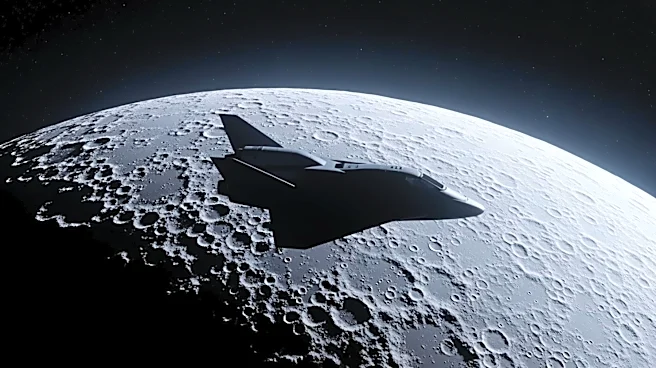
NASA's Artemis II mission is set to achieve a significant milestone as its crew prepares for a historic lunar flyby. The mission, which marks the first crewed flight of NASA's Space Launch System rocket and the Orion spacecraft, aims to test critical
systems for future deep-space exploration. The four-person crew, consisting of Commander Reid Wiseman, Pilot Victor Glover, Mission Specialist Christina Koch, and Canadian astronaut Jeremy Hansen, will travel farther from Earth than any humans have in over 50 years. The mission's trajectory will take them on a figure-eight path around the moon, similar to the Apollo 13 mission, but will exceed the previous distance record by over 4,100 miles. This mission is a crucial step in NASA's long-term goal of establishing a sustained human presence on the moon and preparing for future Mars missions.
Why It's Important?
The Artemis II mission is pivotal for NASA's ambitions to extend human exploration beyond low Earth orbit. By testing life-support systems, navigation, and communication technologies, the mission aims to validate the spacecraft's performance for more complex future missions. The success of Artemis II will pave the way for subsequent missions, including Artemis III, which will involve lunar landings and surface operations. This mission also holds historical significance as it includes the first non-American, first woman, and first Black astronaut to travel to the moon. The advancements and data gathered from this mission will contribute to the broader scientific understanding of the moon and its potential as a base for further space exploration.
What's Next?
Following the lunar flyby, Artemis II will begin its return journey to Earth, with a planned splashdown in the Pacific Ocean near San Diego. The mission's completion will set the stage for Artemis III, which is targeted for 2027 and will test docking operations with commercial lunar landers. The lessons learned from Artemis II will inform the planning and execution of future missions, including the first crewed lunar landing under the Artemis program, expected with Artemis IV in 2028. These missions are part of NASA's strategy to establish a sustainable human presence on the moon and eventually conduct missions to Mars.