



What's Happening?
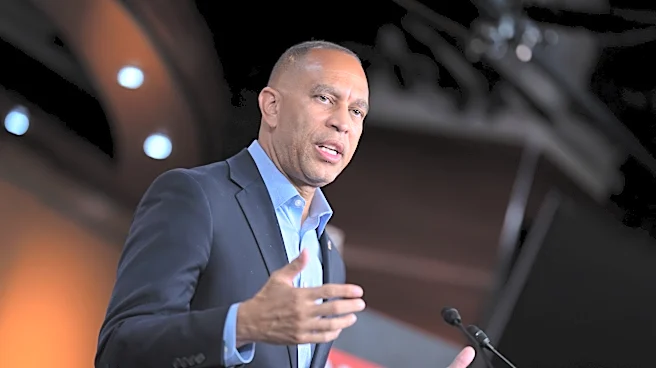
Representative Ritchie Torres, a Democrat from New York, has publicly condemned Palestinian journalist Rula Jebreal for referring to House Democratic Leader Hakeem Jeffries as a 'monkey' and an 'errand boy.' Torres unequivocally stated that calling a Black
man a 'monkey' is racist, full stop. He further criticized what he perceives as a double standard within parts of the political left regarding the condemnation of such remarks. The Congressional Black Caucus also issued a strong condemnation of Jebreal's comments, emphasizing that there is no non-racist interpretation for calling a Black man a 'monkey' or 'errand boy.' Jebreal made these remarks during an appearance on 'The Left Hook' podcast, where she attacked Jeffries over his support for Israel, initially claiming she did not intend the comment in a racist way and later attempting to explain it by referencing the 'three wise monkeys.'
Why It's Important?
This incident highlights the ongoing challenges of combating racism and the complexities of political discourse, particularly when it intersects with identity and international relations. The strong condemnation from Representative Torres and the Congressional Black Caucus underscores the zero-tolerance stance against racially charged language within U.S. political circles, especially when directed at Black leaders. The debate over Jebreal's remarks and her subsequent explanation also brings to light the differing interpretations of what constitutes racist language and the potential for such comments to carry antisemitic implications, as suggested by Jonathan Chait. This event could further polarize discussions around U.S. foreign policy, particularly concerning Israel, and may lead to increased scrutiny of public figures' rhetoric on social media and other platforms.
What's Next?
The condemnation from Representative Torres and the Congressional Black Caucus is likely to maintain pressure on Rula Jebreal to issue a more comprehensive apology or face continued criticism. This incident may also prompt further discussions within the Democratic Party and broader political discourse about the boundaries of acceptable language, especially when criticizing political figures. There could be calls for social media platforms and podcast hosts to more actively moderate content that contains racist or bigoted language. The event might also influence how public figures engage in debates about sensitive topics like U.S.-Israel relations, potentially leading to more cautious or carefully worded statements to avoid similar controversies. The focus will remain on how political leaders and the public respond to and address instances of perceived racism in public commentary.
Beyond the Headlines
Beyond the immediate controversy, this incident touches upon deeper societal issues regarding racial stereotypes and the historical context of derogatory terms. The use of 'monkey' as a slur against Black individuals carries a long and painful history of dehumanization, making any attempt to rationalize its use highly problematic. The perceived double standard highlighted by Representative Torres also points to a broader debate about consistency in condemning racism across the political spectrum. This event could serve as a catalyst for renewed conversations about accountability in public discourse and the responsibility of individuals, regardless of their political leanings, to avoid language that perpetuates harmful stereotypes. It also underscores the persistent challenge of addressing racism in an increasingly interconnected and often polarized media landscape.