
What's Happening?
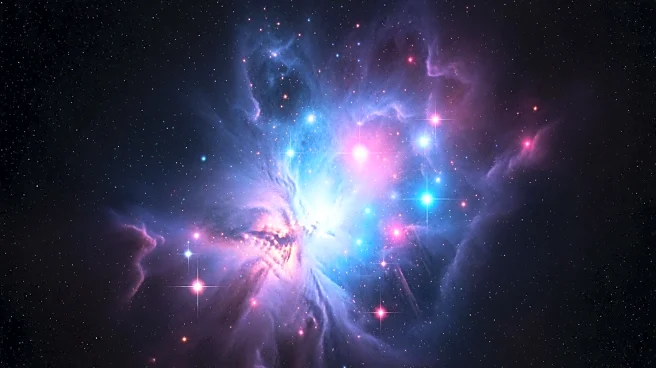
NASA's Hubble Space Telescope has captured a new image of the star-forming region NGC 1333, located about 950 light-years away in the Perseus molecular cloud. The image reveals a collection of young stellar
objects, including a protostar and a planet-forming disk. The protostar's glow creates a reflection nebula, while its protoplanetary disk casts a shadow across the surrounding material. The image also features Orion variable stars, which change in brightness due to stellar flares and ejections. These observations help scientists study the properties of circumstellar disks and the processes involved in star formation.
Why It's Important?
The new Hubble images provide valuable insights into the early stages of star formation and the conditions that lead to the creation of planetary systems. By studying young stellar objects and their environments, scientists can better understand the processes that govern the birth and evolution of stars and planets. This research contributes to our knowledge of the universe and the potential for life beyond Earth. The findings also demonstrate the continued importance of the Hubble Space Telescope in advancing astronomical research and expanding our understanding of cosmic phenomena.