
What's Happening?
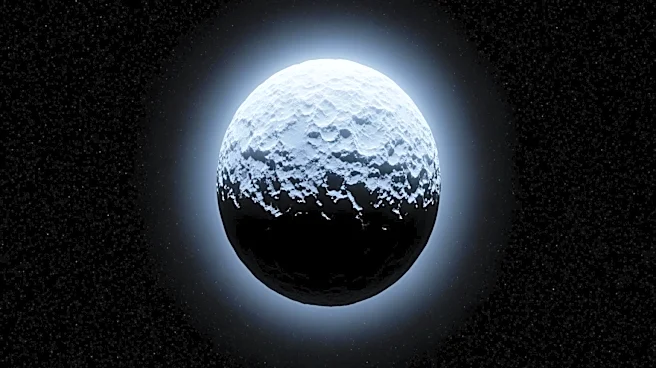
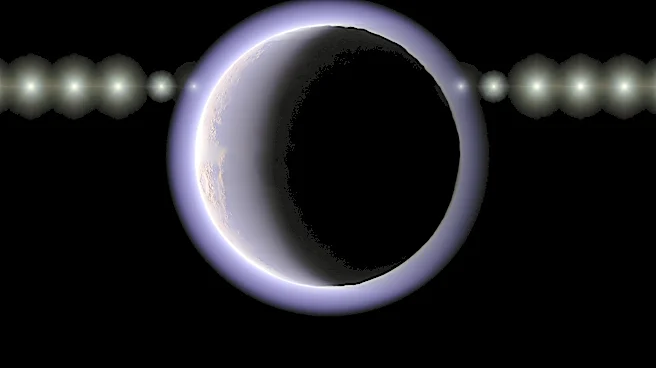
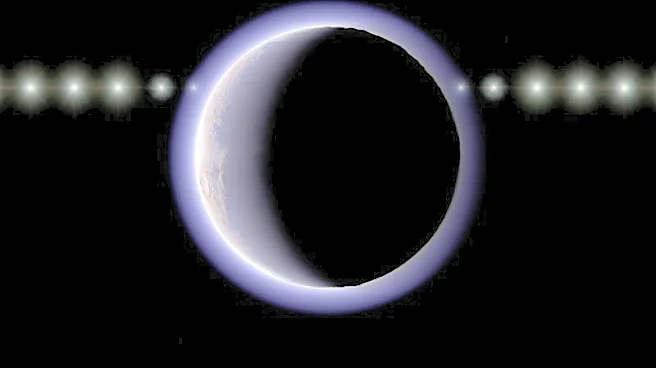
Japanese astronomers have discovered a thin atmosphere surrounding a trans-Neptunian object, designated (612533) 2002 XV93, located in the Kuiper Belt. This object, known as a 'plutino,' is in a 2:3 orbital
resonance with Neptune and measures approximately 311 miles across, making it significantly smaller than Pluto. The discovery was made during a rare stellar alignment, where the object passed in front of a distant star, causing a subtle dimming of starlight. This dimming suggested the presence of an atmosphere, which is unexpected given the object's small size and cold environment. The findings, published in Nature Astronomy, challenge existing assumptions about which celestial bodies can sustain atmospheres. The atmosphere is estimated to be extremely thin, about 5 million to 10 million times thinner than Earth's, and is not expected to be permanent.
Why It's Important?
The discovery of an atmosphere on (612533) 2002 XV93 is significant as it challenges current understanding of atmospheric retention on small, distant celestial bodies. If confirmed, this finding could have profound implications for planetary science, particularly in understanding the conditions that allow atmospheres to form and persist in the outer solar system. The presence of an atmosphere on such a small object suggests that other trans-Neptunian objects might also possess atmospheres, potentially altering the criteria used to study and classify these distant bodies. This could lead to a reevaluation of the processes that contribute to atmospheric formation and retention in extreme environments.
What's Next?
Further observations are necessary to confirm the existence of the atmosphere on (612533) 2002 XV93. Researchers are keen to use the James Webb Space Telescope (JWST) for follow-up studies, which could provide more detailed insights into the atmosphere's composition and origin. If the atmosphere is confirmed, scientists will investigate whether it is sustained by internal processes, such as cryovolcanism, or if it resulted from an external impact. The outcome of these studies could influence future exploration missions and the search for atmospheres on other distant objects in the solar system.