





What's Happening?
New research from the University of North Carolina at Chapel Hill indicates that medically vulnerable older adults face persistent health risks long after hurricane flooding subsides. The study, published in the Journal of the American Geriatrics Society,
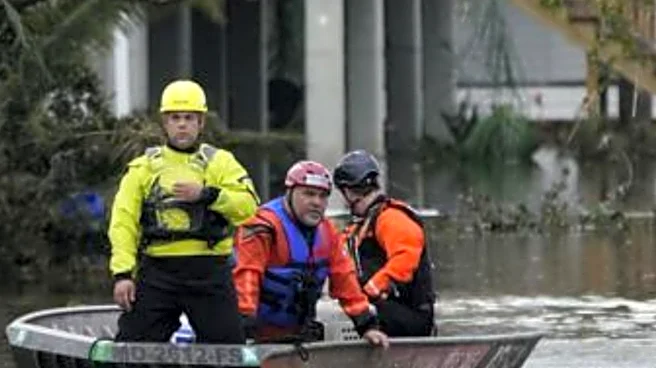
examined hospitalization and death rates among North Carolina Medicare beneficiaries aged 65 and older who rely on electricity-dependent medical equipment, such as ventilators and oxygen machines. Researchers, including first author Bradford Jackson, PhD, and senior author Jennifer Lund, PhD, analyzed health outcomes before and after Hurricanes Matthew (2016) and Florence (2018). They found that while broad county-level disaster declarations did not immediately show significant increases in adverse health outcomes, more detailed data on the percentage of residential buildings flooded within a county revealed a clearer pattern. Greater flooding was strongly associated with more pronounced and lasting increases in hospitalization or death, particularly among Black Medicare beneficiaries, whose short- and long-term outcomes worsened with increased flooding severity.
Why It's Important?
This research is significant because it highlights a critical vulnerability within the healthcare system and disaster response strategies. It demonstrates that current broad disaster classifications, such as FEMA declarations at the county level, may not adequately capture the nuanced impacts of natural disasters on specific populations. The findings suggest that a more granular understanding of flooding extent is necessary to identify and support those most at risk. For older adults dependent on medical equipment, power outages and infrastructure damage can be life-threatening, and the study reveals these risks can extend far beyond the immediate aftermath of a storm. The disproportionate impact on Black Medicare beneficiaries also points to existing health disparities that are exacerbated during and after natural disasters, underscoring the need for equitable disaster preparedness and recovery efforts. This insight can inform more targeted interventions and resource allocation, potentially saving lives and improving health outcomes for vulnerable populations.
What's Next?
The findings suggest a clear path forward for emergency planners and public health officials. The next steps should involve integrating more precise flood data, such as that from the North Carolina Flood Extent Archive, with health care utilization data to better identify medically vulnerable residents. This integration can help emergency planners pinpoint specific neighborhoods and individuals who require enhanced support during and after natural disasters. Community organizations and local and state agencies can leverage this information to strengthen disaster preparedness and planning, ensuring that resources like backup power, medical supplies, and transportation assistance are directed to those most in need. Future research could also explore the effectiveness of targeted interventions based on these more precise risk assessments. Additionally, policymakers may consider revising disaster declaration criteria to incorporate more detailed environmental impact data, moving beyond broad county-level assessments to address localized vulnerabilities.
Beyond the Headlines
This study delves into the deeper implications of climate change and natural disasters on public health, particularly for an aging population with complex medical needs. It exposes the limitations of current disaster response frameworks that may overlook critical disparities within affected communities. The emphasis on precise flooding data rather than broad declarations underscores a shift towards more data-driven and localized approaches to disaster management. Ethically, the findings call for a re-evaluation of how society protects its most vulnerable members during crises, highlighting the need for equitable access to resources and support. Culturally, it reinforces the importance of community-led initiatives and input in shaping research and response strategies, as the study itself was initiated in response to concerns from hurricane-affected communities. Long-term, this research could drive policy changes that prioritize resilience planning for medically fragile populations, ensuring that disaster preparedness is not a one-size-fits-all approach but rather tailored to specific community needs and vulnerabilities.