







What's Happening?
David J. Hayes, who served as U.S. Deputy Secretary of the Department of the Interior in three presidential administrations and as Special Assistant to the President for Climate Policy, is emphasizing the critical need for accessible and usable climate
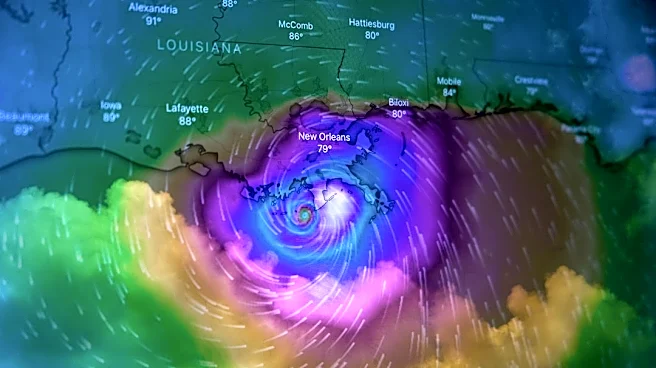
and environmental data. Hayes, currently an Advisory Board Member and Co-Founder of the Center for Climate and Environmental Data (CCED) at the Data Foundation, highlights issues such as data fragmentation, lack of measurement standards, and insufficient granularity. He points out that greenhouse gas data, for instance, is spread across various federal scientific agencies like NASA, NOAA, and USGS, as well as policy-making bodies such as the U.S. Department of Agriculture and the U.S. Department of Energy. This fragmentation makes it challenging for decision-makers, from foresters considering reforestation projects to city managers evaluating tree planting initiatives, to access and utilize the data effectively for actionable insights. Hayes's interest in environmental data stems from his time at the Department of the Interior in the 1990s, where he recognized the power of data visualization, particularly GIS mapping, in conveying information to government leaders.
Why It's Important?
The push for better climate and environmental data is crucial for the United States' ability to address climate change and protect its natural resources effectively. Fragmented and inconsistent data hinders the development and implementation of sound environmental policies and investments. Without trusted, high-quality measurement data, the case for investing in natural climate solutions like reforestation is weakened, and the ability to quantify their benefits remains limited. This impacts various stakeholders, including federal agencies responsible for land management, local governments making environmental decisions, and private entities involved in voluntary carbon markets. The lack of consensus-based standards for data collection and sharing erodes trust and impedes the aggregation of information needed for comprehensive climate action. Improving data accessibility and standardization would empower decision-makers across all levels to make more informed choices, leading to more efficient resource allocation and more impactful environmental outcomes. This initiative could also foster greater collaboration between government, academia, and the private sector in tackling complex environmental challenges.
What's Next?
The Center for Climate and Environmental Data (CCED), co-founded by David Hayes, will continue its efforts to address the challenges of climate and environmental data. This includes working on issues such as fragmentation, lack of measurement standards, and granularity. Organizations like the Data Foundation are expected to play a significant role in convening stakeholders and fostering consensus on data standards. The focus will be on developing mechanisms to ensure that government and private parties collect and make available high-quality, actionable greenhouse gas measurement and monitoring data. This involves moving beyond broad atmospheric models to provide more granular data relevant for project-level decisions. The National Institute of Standards and Technology (NIST) is identified as a key entity for developing these data standards. The ongoing discussions at events like Climate Week NYC, where data figures prominently, suggest continued momentum towards improving data infrastructure for climate action. The goal is to build trust in the data and establish robust standards that facilitate its sharing and aggregation.
Beyond the Headlines
The underlying issue of data fragmentation and lack of standardization in climate and environmental information extends beyond mere technical challenges; it touches upon fundamental aspects of governance, public trust, and economic valuation of natural assets. The inability to accurately measure and verify environmental impacts and benefits can undermine the credibility of climate initiatives and hinder the growth of nascent markets, such as voluntary carbon markets. Ethical considerations arise regarding data ownership, privacy, and equitable access, particularly for communities disproportionately affected by environmental changes. Furthermore, the integration of diverse data sets from various federal agencies and private sources requires a sophisticated interoperability framework, which could set a precedent for data sharing in other complex policy domains. The long-term shift could involve a more data-driven approach to environmental management, where policy decisions are increasingly informed by real-time, verifiable data, potentially leading to more adaptive and resilient environmental strategies across the U.S.