



What's Happening?
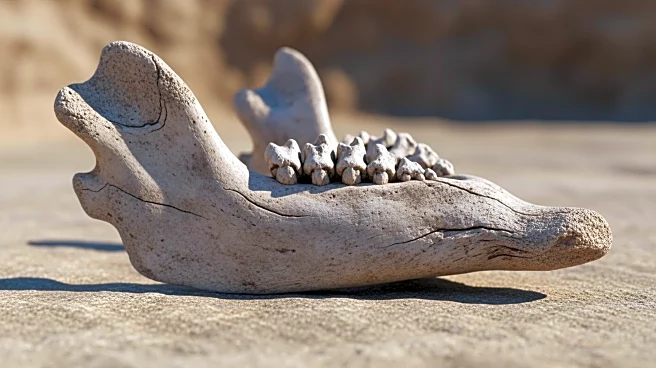
A 2.6 million-year-old fossil jaw from the genus Paranthropus has been discovered in northeastern Ethiopia, altering the understanding of early human evolution. The jaw, found in the Afar region, suggests that Paranthropus hominins traveled farther north than
previously thought. This discovery challenges the assumption that Paranthropus did not inhabit the Afar region, where other hominins were present. The fossil indicates that Paranthropus had a flexible diet, allowing them to adapt to diverse environments. The find adds a third genus to the hominins known to have lived in the region, alongside Australopithecus and early Homo.
Why It's Important?
The discovery of the Paranthropus jaw in Ethiopia provides critical insights into the distribution and adaptability of early hominins. It suggests that these species were capable of exploiting a variety of habitats, similar to Australopithecus and Homo. This challenges the traditional view of human evolution as a linear progression and highlights the complexity of hominin diversity. Understanding the ecological and dietary flexibility of Paranthropus could inform studies on human adaptability and resilience. The find also emphasizes the importance of revisiting established hypotheses about human evolution.
What's Next?
Researchers will continue to analyze the Paranthropus jaw to uncover more details about its diet and ecological adaptations. This may involve comparative studies with other hominin fossils to better understand the interactions and coexistence of different species. The discovery could lead to new hypotheses about the migration and evolution of early hominins in Africa. Further excavations in the Afar region may reveal additional fossils, providing a more comprehensive picture of the region's prehistoric inhabitants.
Beyond the Headlines
The discovery prompts a reevaluation of the narrative of human evolution, emphasizing the diversity and complexity of hominin species. It challenges the notion of a single lineage leading to modern humans, suggesting a more interconnected evolutionary history. This perspective encourages a broader understanding of human ancestry, recognizing the contributions of various hominin species. The find also highlights the importance of interdisciplinary research in uncovering the nuances of human evolution.