



What's Happening?
Richard Lindsay, the United Kingdom's special envoy for Afghanistan, has congratulated Afghan women on receiving the 2026 Chatham House Prize. Lindsay attended the award ceremony and highlighted the UK's support for Afghan women, stating that their full
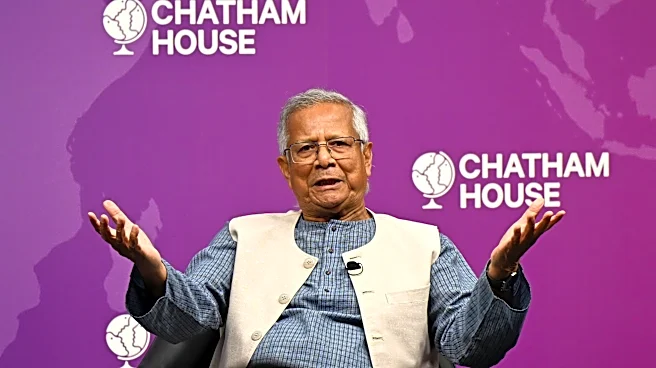
participation in society is essential for Afghanistan's future stability and prosperity. The Chatham House Prize is presented by Chatham House, a London-based international affairs think tank. Lindsay's remarks, shared on X, underscored the importance of women's involvement in Afghan society.
Why It's Important?
This recognition by Chatham House and the public acknowledgment by the UK envoy serve to highlight the critical role of Afghan women, particularly in a context where their rights and participation are severely restricted. Such international recognition can provide moral support and draw global attention to the challenges faced by women in Afghanistan. It also reinforces the message that the international community views women's full participation as integral to the country's long-term stability and development, counteracting the Taliban's policies that seek to exclude them from public life. This can contribute to sustained advocacy efforts for women's rights.
What's Next?
While the award and the envoy's comments offer symbolic support, the practical impact on the ground in Afghanistan remains to be seen. The UK's continued diplomatic engagement and support for Afghan women will be crucial. Such international recognition can serve as a platform for further advocacy and potentially influence policy discussions among international actors regarding Afghanistan. However, direct changes in the Taliban's policies are not immediately indicated by this event. The focus will likely remain on sustained international pressure and support for civil society initiatives within Afghanistan.
Beyond the Headlines
The Chatham House Prize for Afghan women, coupled with the UK envoy's statement, represents a significant symbolic gesture in the ongoing struggle for women's rights in Afghanistan. It underscores the global recognition of their resilience and the importance of their contributions, even in the face of extreme adversity. This event also highlights the role of international think tanks and diplomatic efforts in shaping narratives and advocating for human rights. It implicitly challenges the Taliban's narrative by affirming the value of women's participation, suggesting a long-term commitment from parts of the international community to support Afghan women despite the current political climate.