
What's Happening?
An international team of astronomers, including researchers from the University of Hong Kong, has discovered that some fast radio bursts (FRBs) originate from binary stellar systems. This finding was made
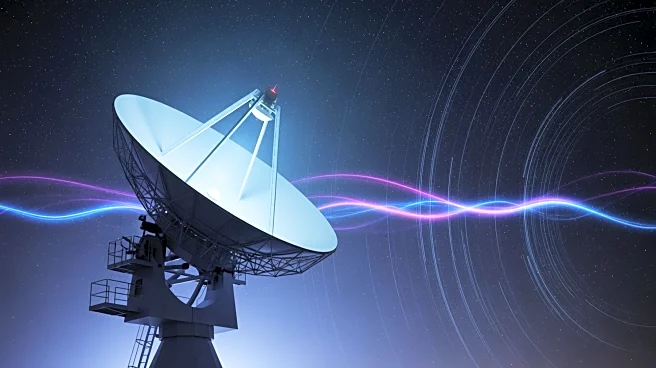
using the Five-hundred-meter Aperture Spherical Telescope (FAST), also known as the 'China Sky Eye.' The team detected a distinctive signal indicating the presence of a companion star orbiting the FRB source, challenging the previous assumption that these bursts came from isolated stars. The discovery was based on nearly 20 months of monitoring an active repeating FRB located about 2.5 billion light-years away. A rare phenomenon known as an 'RM flare' was observed, suggesting a coronal mass ejection from a companion star. This supports the theory that at least some repeating FRBs originate from binary systems containing a magnetar and a sun-like star.
Why It's Important?
This discovery is significant as it provides a new understanding of the origins of fast radio bursts, which are powerful but brief flashes of radio waves from distant galaxies. Understanding the binary nature of some FRB sources could lead to advancements in astrophysics, particularly in the study of magnetars and their interactions in binary systems. This could also enhance the ability to predict and study these phenomena, offering insights into the behavior of neutron stars and the environments in which they exist. The findings may influence future research directions and observational strategies in the field of radio astronomy.
What's Next?
Continued long-term monitoring of repeating FRBs is expected to reveal how common binary systems are among these sources. The research team plans to use the world's best telescopes, including FAST and Australia's Parkes telescope, to further investigate these phenomena. This ongoing research could lead to a more comprehensive understanding of the mechanisms behind FRBs and their potential applications in studying the universe. The findings may also prompt further theoretical work to refine models of FRB origins and their interactions with surrounding environments.
Beyond the Headlines
The discovery of the binary origin of some FRBs highlights the importance of international collaboration and the use of advanced technology in astrophysics. It underscores the role of large-scale telescopes like FAST in making groundbreaking discoveries. This research also contributes to the broader understanding of stellar evolution and the complex dynamics within binary systems. The implications of this study extend beyond astrophysics, potentially impacting related fields such as cosmology and space exploration.