






What's Happening?
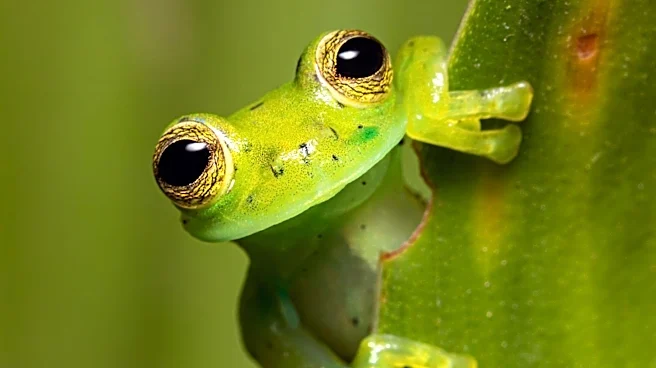
A new VICE documentary features Amber Rawlings (referred to as Amber 'AD' Smith in the query, but as Amber Rawlings in the article) as she investigates the growing trend of suburban individuals in the UK using kambo, a venom derived from the giant monkey
frog. The documentary highlights various kambo ceremonies where participants ingest the venom, often leading to intense vomiting, in pursuit of perceived physical and spiritual healing. These ceremonies are conducted by part-time shamans who source the venom from Indigenous rainforest tribes. While not illegal in the UK, kambo is not a licensed medicine, and there have been reported fatalities globally associated with its use. Rawlings's interest in kambo stemmed from interviewing 'tripsitters,' and the documentary delves into the motivations of those seeking this unconventional remedy, often driven by disillusionment with conventional medicine and the influence of social media promotions.
Why It's Important?
This documentary sheds light on a concerning trend of unregulated alternative health practices gaining traction, particularly among those seeking remedies outside of conventional medicine. The lack of clinical evidence supporting kambo's efficacy and the reported fatalities raise significant public health and safety concerns. The phenomenon underscores a broader societal issue where individuals, influenced by misinformation and social media, turn to unverified treatments. This trend can have serious implications for public health, as it diverts individuals from evidence-based medical care and exposes them to potentially dangerous substances. The documentary also touches upon the ethical considerations of sourcing traditional remedies from Indigenous communities and their commercialization in Western contexts without proper regulation or understanding.
What's Next?
The documentary's release is likely to spark further discussion and debate regarding the regulation of alternative therapies and the spread of health-related misinformation. It may prompt health authorities to re-evaluate existing regulations or consider new guidelines for substances like kambo, especially given the reported fatalities. Increased public awareness of the risks associated with unregulated practices could lead to a decline in participation or, conversely, a surge in interest from those seeking unconventional solutions. The documentary also implicitly calls for greater scrutiny of how such practices are promoted on social media and the responsibility of platforms in curbing the spread of unverified health claims. Future developments could include more in-depth investigations into the sourcing and distribution networks of kambo and similar substances.
Beyond the Headlines
The documentary delves into the deeper societal anxieties and distrust in established institutions that drive individuals towards alternative practices. The 'woo-woo' aspect, as described by Rawlings, highlights a cultural shift where spiritual and pseudo-scientific beliefs intertwine with health-seeking behaviors. This trend reflects a broader disillusionment with modern medicine and a yearning for holistic or 'natural' solutions, even when they lack scientific backing. The commercialization of traditional Indigenous remedies, often without proper cultural context or benefit-sharing, also raises ethical questions about exploitation and cultural appropriation. The documentary subtly critiques the 'god complex' of some practitioners and the superficiality of certain 'spiritual' settings, suggesting a commodification of spiritual experiences. Ultimately, it points to a complex interplay of health, belief systems, and the search for meaning in a 'fucked' world.